The Pennsylvania Civil War Road Show appears in this cool video on its first stop at Sen. John Heinz History Center in Pittsburgh. The cool museum and whatever comes with it will be stopping in each of Pennsylvania's 67 counties over the next four years, the duration of the war among the states. The video is courtesy of The Borden Agency. Make sure to check the traveling museum out when it pulls in near you. Click here to read my review on the Pittsburgh tour.

Tuesday, June 28, 2011
Civil War road show on the go
The Pennsylvania Civil War Road Show appears in this cool video on its first stop at Sen. John Heinz History Center in Pittsburgh. The cool museum and whatever comes with it will be stopping in each of Pennsylvania's 67 counties over the next four years, the duration of the war among the states. The video is courtesy of The Borden Agency. Make sure to check the traveling museum out when it pulls in near you. Click here to read my review on the Pittsburgh tour.

Monday, June 27, 2011
Indians own naming rights to Mon River

By Scott Beveridge,
FREDERICKTOWN, Pa. - Judging from the massive spring landslide that buried a road along the Monongahela River near Fredericktown, the Indians who once roamed the region were onto something when they called it the "river with falling-in banks."
No one knows for sure, though, which European settler stood along its banks and proclaimed it should be named the Monongahela, said historian John K. Folmar of nearby California.
"It was just used by the first white guys who heard them talking. There was no unification as to how to spell it," said Folmar, a retired history professor at California University of Pennsylvania.
Journalists who covered the May 13 landslide at a steep cliff near the river that put 1,700 tons of rock, mud and debris on Route 88 were reminded of what they thought was a legend about the naming of the river.
But it turns out to be a true story about Indians using the word to describe a river with unstable banks, according to Folmar's research.
There is a mention in the 1937 book, "The Monongahela: The River and its Region" by Richard T. Wiley about a Moravian missionary named John Heckewelder hearing the word while laboring among the Delawares, Folmar said. Heckewelder collected in the 1760s the names the Delawares had given to Pennsylvania's rivers, and spelled Monongahela Menaungehilla.
It wasn't until the Pittsburgh Post-Gazette on July 26, 1786, published a story about the naming rights to the river that a reputable source linked the name to the American Indians, Folmar said.
That story indicated the word had signified in some of the Indian languages a river with "falling-in banks," or a stream with collapsing or mouldering banks, Folmar said.
There were still as many as 20 different spellings for the river name, and the county around Morgantown, W.Va., calls itself Monongalia to this day.
Of course the river didn't look as it does today, either, before it was transformed in the 20th century into a network of locks and dams with pools maintaining a navigation depth of at least 9 feet. People could walk across the Mon during drought season, including one in the 1860s when that was possible to do that between Pittsburgh and its South Side, Folmar said.
And, he said, there were no tribes native to Southwestern Pennsylvania living in the area when the European settlers began to arrive in the 1700s. It remains a great mystery as to why the native mound builders disappeared, leaving behind vast archaeological evidence of their primitive settlements, Folmar said.
"It would have been a different history had there been Indians in the valley when the white folk arrived here," Folmar said.
Those tribes had been gone for hundreds of years. The natives who did show up had moved in from the West to take part in frontier battles with the French as the New World was expanding, Folmar said.
He then joked that the river's name would be appropriate to describe the blight the Mon Valley has experienced in the decades since the steel industry collapsed in the 1980s.
"The valley is crumbling in more ways than one," he said.
(This story first appeared in the Observer-Reporter May 23, 2011)
Tuesday, June 21, 2011
A hot-selling poor man's sandwich

At some point when I was a kid an adult suggested we fry bologna for sandwiches when there wasn't much else in the refrigerator at home.
It was probably one of those days when my dad was walking the picket line during labor problems at his Monessen, Pa., steel mill and the strike pay wasn't enough to meet the bills.
I remember feeling poor until getting a taste of that cheap sausage and lard lunchmeat blackened in butter in a cast iron skillet and thinking it was delicious. It soon became a staple in our house even when times were good and until I grew up and eventually quit buying processed meats.
So it came to my surprise tonight when I discovered a fried bologna - pronounced baloney - sandwich on the menu at a tavern along the Monongahela River south of Pittsburgh.
Elrama Tavern on Route 837 in Elrama churches up its version of this Great Depression-era delicacy by topping it with hot pepper cheese between two slices of Texas toast. The spicy cheese was an excellent compliment this great sandwich at the business in Washington County.
"We sell a lot of them," my server said, seeming surprised that I thought it odd that any restaurant would even have such an item on its menu.
The place with a mostly rustic decor around a 1930s Art Deco bar was filled with customers enjoying a Tuesday Margarita party. The staff wore matching blue floral Hawaiian print blouses, and one server's outfit was offset by a bright yellow grass skirt. A guitar playing man was singing beach songs on the back deck on an otherwise sleepy night in this coal patch.
My bill came to cheap $10.07 for a meal that included French fries and two large drafts of Yuengling. Now that was a throw back price to the days when cooks on a tight budget could make anything taste great.
Saturday, June 18, 2011
This pen eases my guilt

Water is the only liquid that satisfies my thirst and I don't like contributing to the flow of new plastic into landfills or recycling bins. But I do. Every day.
Well the Jacksonville, Fla.-based Pilot Corporation of America has come up with a pen that eases my guilt over buying so many of those bottles of water.
It has introduced the world's first ink pen manufactured from recycled plastic bottles. Its B2p gel roller is cool because its body even looks a bit like a tiny bottle of water. And the pens are refillable, which makes me even happier.
In my job as a reporter I use/lose a lot of pens.
I bought mine yesterday at a Rite Aid in Monongahela, Pa. The pens also can be purchased at Staples, Walgreens, Amazon, Walmart and Office Depot and starting next month, Target, the company tells me today in a Tweet.
(This blog does not do paid product endorsements)
Wednesday, June 15, 2011
A dog's life on a 19th Century farm
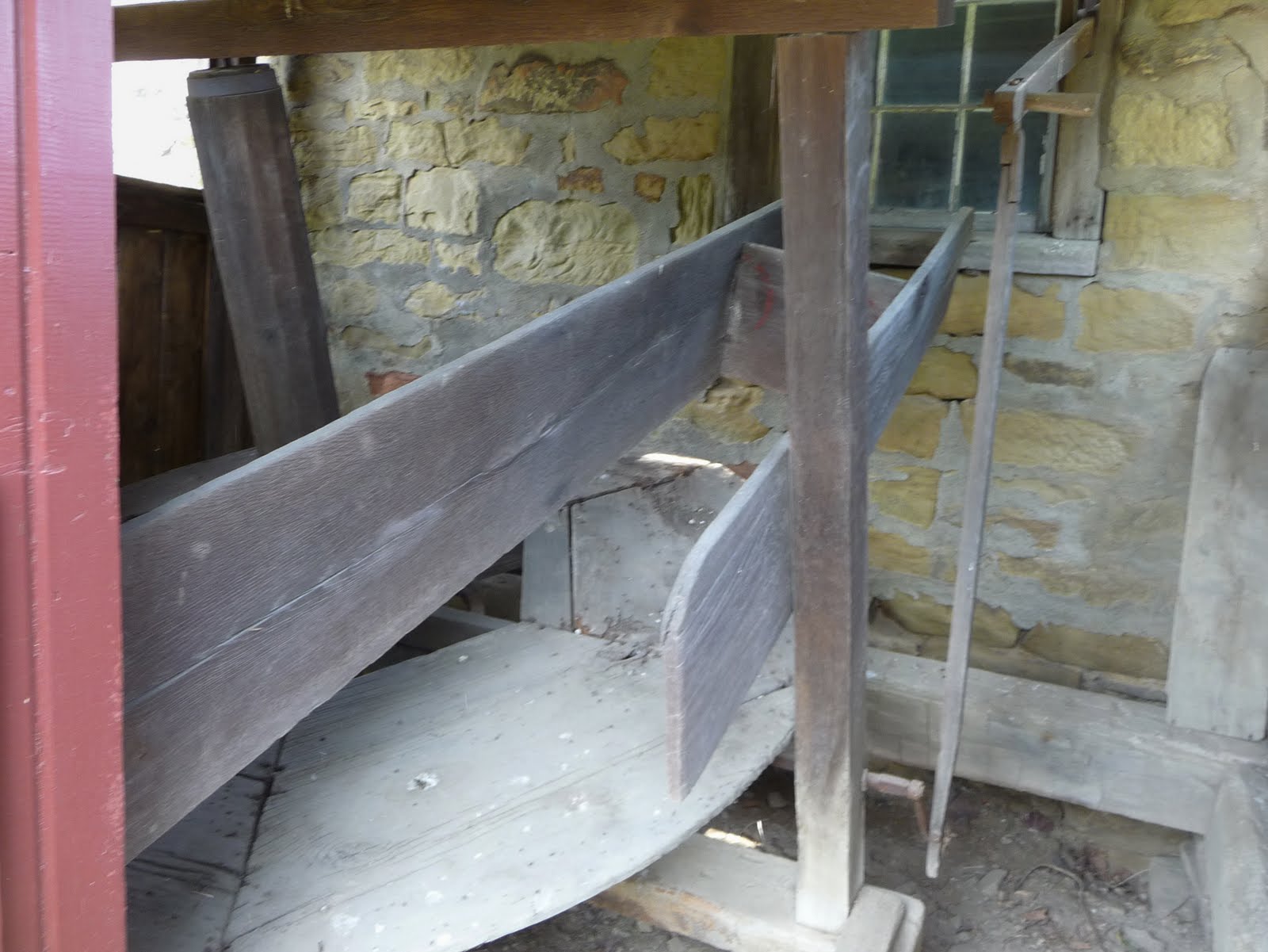
A dog powered butter churn on the historic Manchester Farm near Avella, Pa. (Scott Beveridge photo)
Historic Farm is threatened by longwall mining
By Scott Beveridge
AVELLA – Dogs used to be good for something other than companionship or fetching the morning newspaper.
Those owned by 19th Century farmer Isaac Manchester earned their table scraps by churning butter while running on a spinning wheel contraption beside the summer kitchen.
“You just put some food in front of it, and …,” said Manchester’s great-great-great-great-great granddaughter Marcie Pagliarulo, who now owns the farm in Independence Township, Pa.
The churn, along with a treasure trove of antique household and farming artifacts, have survived here thanks to the preservation efforts of generations of Manchesters.
The property likely holds the only existing, intact records of two centuries of farm life in the United States, preservationists said today, when the Manchester farm has become threatened by industrial development.
The Washington, D.C.-based National Trust for Historic Preservation today placed the farm on its annual list of America’s most endangered historic places because a coal operator has plans to open a longwall mine in the area. The method of deep mining proposed by Alliance Resource Partners of Tulsa, Okla., usually results in immediate subsidence damage to houses and private water supplies.
The trust is hoping pressure from its powerful influence will convince the company and Pennsylvania’s mining regulators to find alternatives to damaging the 400-acre farm.
“It’s a very important property for America as well as my family,” Pagliarulo said.
She has spent the past five years since she and her husband, Joe, bought the place cataloging thousands of artifacts stored in their stately Georgian manor house and in the farm’s outbuildings, which include a large barn, whisky distillery, tool shed and carriage house.
“I feel like I’ve gotten to know all of my ancestors,” she said.
Manchester was an English immigrant when he first settled in Newport, RI. He stopped en route to scout land in the Midwest at the Independence Township property when it was a frontier fort owned by Samuel Teeter. Upon his return in 1797 he decided to purchase the property on which he first built the distillery and then the brick house, beginning in 1805.
The Washington County farmhouse is unusual to southwestern Pennsylvania because it was constructed in a style common to Newport, complete with a East Coast widow’s walk on the roof. The barn, too, has details such as a large thrashing room common to New England.
“It’s like a time capsule,” Joe Pagliarulo said.
From today’s Observer-Reporter newspaper in Washington, Pa.:
The National Trust for Historic Preservation pleaded with a coal operator Wednesday to mine in the room-and-pillar method to protect a more than 200-year-old Washington County farm from subsidence damage.
Walter Gallas, a regional director of the trust, also urged supporters to send letters to state lawmakers and Gov. Tom Corbett asking them to take measures to ensure the Isaac Manchester Farm is not damaged by longwall mining.
UPDATE: The coal company announced June 17, 2011, it will not mine in the longwall method under the 400-acre farm, a new release indicated. Alliance Resource spokesman Lee Landon said the company would mine in the conventional, or room-and-pillar approach, to remove the coal reserves it owns there.
(The newspaper has two other stories on the farm on its website)
Monday, June 13, 2011
Houston - we have a problem in national burger contest

By Scott Beveridge
CENTERVILLE, Pa. – Houston may have the best burgers in the United States if you believe the readers of Travel + Leisure who responded to a recent survey conducted by the magazine.
They loved the Texas city’s penchant for serving triple-decker burgers and especially those made with a pound of beef at such places as Lankford Grocery and The Hubcab Grill.
Unfortunately Pittsburgh did not make T+L’s top ten burger joint list because its unlikely the magazine’s comfort foodie readers ever ventured into Southwestern Pennsylvania coal country to eat at Rye’s Bar and Restaurant.
That restaurant on a back road in Centerville has a sandwich named the Vestaburger, which is almost too big to handle and as sloppy as the muddy banks of the nearby Monongahela River. It’s named after a coal patch here where strong men once worked Vesta Coal Co. mine under the hills of the Mon Valley.
This burger reminds me of home because it tastes just like those my mom prepared in her black cast iron skillet using the cheapest and greasiest cuts of ground beef.
Rye’s tops this great sandwich with charbroiled bacon, cheese, sautéed green peppers, grilled onions and mushrooms, lettuce and tomato and a condiment concocted with the restaurant’s homemade spicy Italian salad dressing and mayonnaise.
Everything on the menu is homemade and served in big portions, a server says after I belly up the bar on a muggy spring evening in June. She points me in the direction of a sign advertising the hearty list of the day’s soups, which includes potato dumpling and the staple, French onion.
I notice another sign next to the front door that jokingly advertises “warm beer, cold food" as she returns to take my order for this coal town burger.
“You should see this place on (chicken) wing night. It’ll be packed,” she says.
The customers on this night mostly appear blue collar, judging by the conversations across the bar. However, the owners have installed a free, nonpassword protected wireless Internet signal for those customers who show up with laptop computers.
A guy is whining about cost cutting problems at a local coal mine. A middle aged man sitting on the next stool and wearing a scruffy beard and beer belly rambles about his distaste for lowlifes who receive government disability checks and use the money to purchase marijuana.
By dinnertime the restaurant in the gutted back room is filled with customers, mostly families.
A waitress scurries to serve them in this remote 1800s brick farmhouse, which has been painted blue/gray at 248 Old National Pike. The two-lane is part of the original 1806 National Road, the first interstate ever built by the federal government. This stretch of country road was first bypassed in the 1920s when the National Road was rerouted, modernized and renamed Route 40, and then even further obliterated after Interstate 70 came along.
Yes. Texas just might be too big to notice the finer things in "Little Washington County."
A waitress scurries to serve them in this remote 1800s brick farmhouse, which has been painted blue/gray at 248 Old National Pike. The two-lane is part of the original 1806 National Road, the first interstate ever built by the federal government. This stretch of country road was first bypassed in the 1920s when the National Road was rerouted, modernized and renamed Route 40, and then even further obliterated after Interstate 70 came along.
Yes. Texas just might be too big to notice the finer things in "Little Washington County."
Subscribe to:
Posts (Atom)