a newspaper man adjusts his pen
Showing posts with label Vietnam. Show all posts

Tuesday, April 24, 2007

Dinner in the delta

Mekong rice farmer welcomes Americans
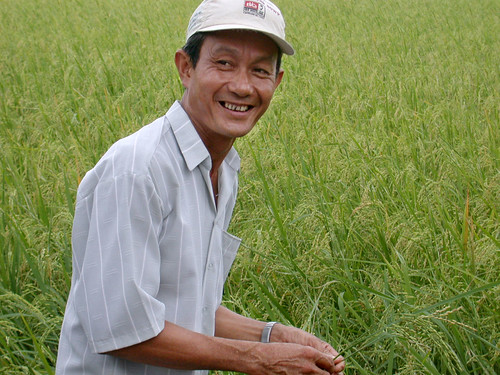
Tu Man, above, has been having good rice harvests, making him a middle-class, head-of-the-household in Vietnam. The average worker in Vietnam is lucky to earn the equivalent of $40 U.S. dollars a month. Tu Man is smiling, too, for impressing his neighbors, by having American visitors.


ALONG THE MEKONG DELTA, Vietnam – The rice boat's engine sputters, stalls and spouts thick, smelly black oil on its passengers.

They wipe themselves down with newspapers and rags while its engine cranks and churns back to life, pushing the boat again down the Mekong Delta.

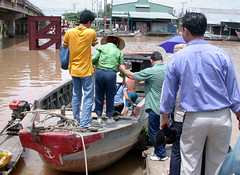
The weathered gray wooden boat is not carrying its normal haul of rice weighing 10 tons. It is parading two Americans on a sweltering mid-July afternoon along the muddy brown delta the Vietnamese call Cuu Long, or River of Nine Dragons.

Vietnam veteran Neal Armagost of Reynoldsville is aboard with his wife, Thanh, a Vietnamese immigrant to Pennsylvania, en route to give a rice farmer photographs of his newborn granddaughter in the United States. An American newspaper reporter is at their side, invited by Thanh Armagost to glimpse the life of an average hard-working farm family in Vietnam.
Delta5

Onlookers, many of whom have probably never seen Americans, smile and stare from thatched huts on stilts lining the riverbank and passing boats hauling exotic fruits.

Children splash at the river's edge while a group of women stoop to wash clothes.

"The water is poison," a young man named Hieu said, blaming the pollution on runoff from rice paddies that have been sprayed too often with pesticides.

Downstream, the farmer's family is preparing a feast that is costing it about $40, the monthly salary earned by most workers in Vietnam.

The boat anchors at a small plank dock after navigating under a narrow bamboo monkey bridge villagers built to cross the river.

Everyone follows a path covered with terra-cotta shards leading to the rice farmer's home, passing well-manicured papaya and mango orchards. A barefoot boy uses his hands and feet to shimmy to the top of a palm tree to retrieve a dozen coconuts to serve the fruit's cool, refreshing milk.

Inside the four-room, one-story white stucco house, a woman drains blood from the neck of a red-feathered chicken that will become dinner.

The menu also includes rice noodle soup with pork and beef, seafood rolls, fresh-baked bread and banh xeo, or Vietnamese pancakes.

Thanh Armagost passes around photographs of 5-month-old Loan Thy Vu, the daughter of her nephew, whom she raised. The baby's mother, who also lives with the Armagosts, is a daughter of the rice farmer, Tu Man.

"I miss her already," said Ba Noi, the grandmother on the father's side of the family. The wrinkles on the 88-year-old woman's tanned face testify to the hours she spends under the sun tending to the vegetables, two-thirds of which are sold to sustain the family.After dinner, Tu Man beams while leading his visitors to his paddies, showing them how he toils in fields, hand-harvesting each stalk of rice. The men return to the head table to share bottles of Saigon beer.

"I respect the American soldiers," said Tu Man, whose youthful appearance helped him avoid serving in the South Vietnam army three decades ago.

He later lines up his family on the front porch in view of the Americans' cameras for a group photograph, a special occasion in this village without such conveniences as telephones.

It is time to return to port, where the farmer leaves his visitors with hugs and kisses on their cheeks.

Tuesday, March 20, 2007

At peace with the dead

Danang: Suny-Brockport lecture on ancestor worship

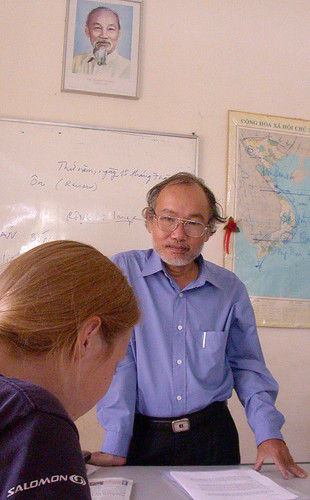
DANANG, Vietnam – On any given day, American students remain standing until their Vietnamese professor gives them permission to be seated.
On this muggy July 2004 afternoon, Vo Van Thang, an English professor at Danang University, is lecturing on ancestor worship.
While there are several religions and a small number of Muslims here, every single person worships their ancestors.
"It looks like a religion but it's not religion," Thang says.
Most houses have an altar to worship ancestors and each village has an altar to worship the ancestors of all the villagers. "The city also has altar," he adds. Meanwhile, every public building has a portrait of former Vietnam President Ho Chi Minh hanging in a prominent place, just like the one above the professor’s right shoulder.
College students from the United States spend a semester earning credits in Vietnamese history and culture through a one-of-a-kind partnership with SUNY Brockport and Foreign Affairs in Danang.
Unlike American co-eds, Vietnamese college students never ask their instructors questions because it is seen as an insult to the instructor, that he is inadequate at his job. This is a country where deceased professors are worshiped as if they are gods.
And in the home, the most important item on an altar are a bowl for josstick, or incense, and a pair of candlesticks.
When burning, the josstick smoke carries prayers or good messages to the heavens. “Every night, even in the city, people are outside burning incense, even in the tree,” Thang said.

Vietnamese ancestor worship

Rather than being fixated on the past, the worship focuses on the dead having a stake in the continuity of life.
Cung Gio is known as the ceremony of the dead, when families and neighbors come together for a party. Tet, or the Vietnamese New Year, is the most important time to worship ancestors, when they “come back and take part in the festivities,” Thang says. “The altar is dressed with new flowers, food, liquor. It’s the time to refurbish the home, buy new clothes...” Another party is thrown on the third day of Tet to see off the ancestors. The Vietnamese typically worship three generations of their deceased relatives.
The Roman Catholic church attempted to stop ancestor worship when it arrived in Vietnam 400 years ago, Thang said. The church later conceded, allowing the people to partake in local superstitions, as long as it is done in the home.
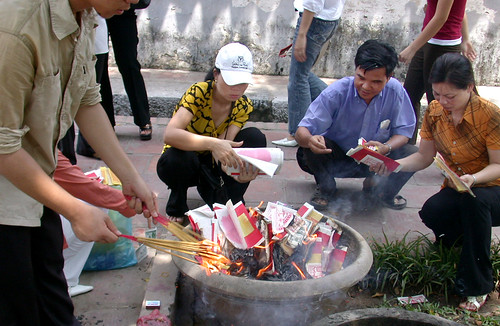
There are other beliefs that the burning of gold or silver paper has the power to send riches to to the sky. Today, people even burn paper cell phones to speed the communication.

Monday, March 19, 2007

Vietnamese businesswomen

Several months ago, Montreal artist Anne Ramsden requested permission to reproduce one of my photographs taken in 2004 in Vietnam. She’s an accomplished artist and professor of visual arts at the University of Quebec. Her work has been exhibited across the globe, from Japan to the United States.

Ramsden is putting together a new exhibit of posters called, “The Museum of the Everyday,” including one of the above photo. She has begun to post the exhibit online at Flickr. So far, however, the images are just available to her list of contacts. It looks like she is putting together an amazing collection of images. Additional information on the exhibit is forthcoming.

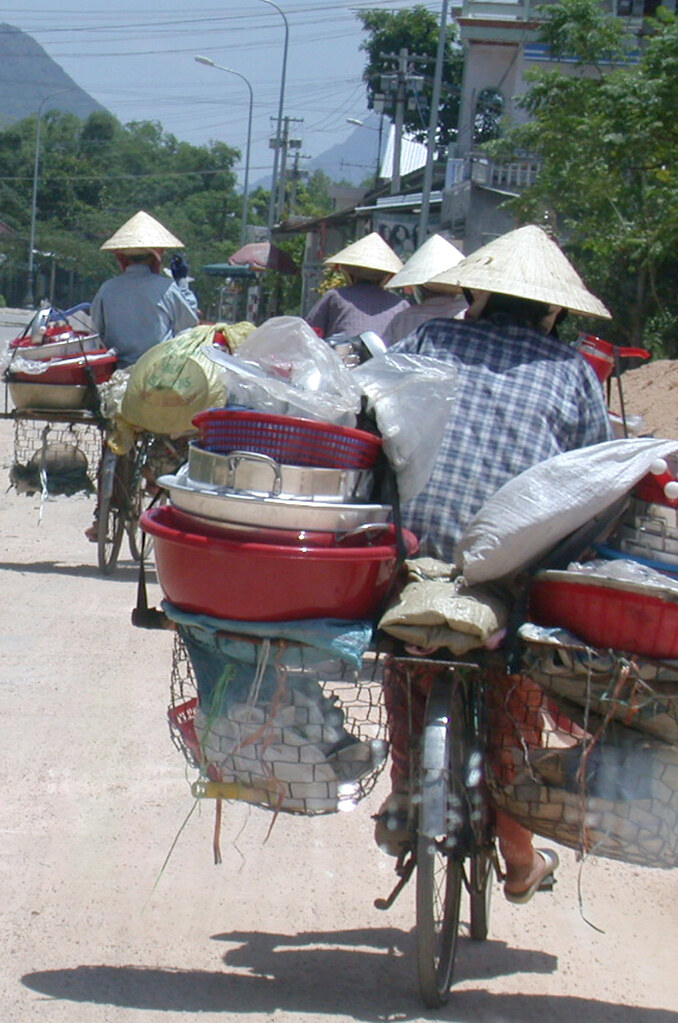
The women shown in this photo pedal their way to the villages, trading new kitchenware for old, for a small fee. They call themselves businesswomen. I happened to snap the shot from inside a moving van while in Vietnam as a 2004 World Affairs Journalism Fellow.

My assignment then was to tell the story of the Friends of Danang of McMurray, Washington County, Pa., a group of Vietnam Veterans whose members have been doing amazing humanitarian work on their former battlefields. Follow this link to a story about what would become some of my most fond memories of the country.