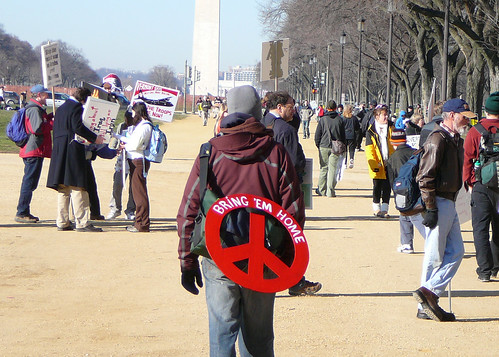
This is what Democracy looks like
Scott Beveridge
Observer-ReporterClean-cut parents in their 30s pushed baby strollers, marching beside female octogenarians wearing hot pink for solidarity last week at a massive anti-war rally in the nation’s capital.
Labor turned out in force, representing the United Steel Workers of America, teachers’ unions and Service Employees International Union. An 80-year-old gentleman took the subway from the suburbs, holding a homemade sign criticizing President Bush’s rhetoric. There also was a showing of young adults wearing
dreadlocks, looking as if they were in need of a bath.
“This is what Democracy looks like,” protesters chanted in the well-orchestrated, peaceful march on the Capitol that bore little resemblance to the turbulent war
demonstrations in the 1960s and 70s.
It was easy to put a face on the anti-war movement during the
Vietnam era.Many proud World War II veterans working in Pittsburgh steel mills called those activists long-haired, unpatriotic queers who were afraid to die for their country.
Actress
Jane Fonda would go on to represent everything evil about the youth movement when she was photographed in Hanoi in 1973, adding her name to the enemy Communist propaganda. She was young and just as naive about foreign policy as the rest of the protesters, many believed then.
It would take nearly a decade for mainstream America to join the opposition to Vietnam. Television newsman
Walter Cronkite, who brought the war into living rooms, would be given credit for turning the masses against the war.
It happened when, thinking he was off air, he questioned whether the White House had been telling the truth about who had the upper hand in Vietnam. “What the hell is going on? I thought we were winning this war,” Cronkite said, reacting to the North Vietnamese army taking over nearly every U.S. stronghold during the surprise Tet offensive in 1968.
The first massive anti-war march would not occur in Washington, D.C., until 1969, when as many as 500,000 people turned out on the Mall separating the Capitol and Washington Monument. Still, it was a movement largely associated with drugs, hippies, peaceniks and college kids. It was five years after the Gulf of Tonkin incident, when the nation was misled into thinking a U.S. vessel had come under attack in North Vietnam in what became the smoking gun that brought U.S. troops to war.
The biggest difference between Vietnam and opposition to the war in Iraq is that it has taken much less time for the anti-war sentiment to galvanize. Large war protest rallies have been filling the streets in cities across the United States, since President Bush launched the war in Iraq March 19, 2003.
The 69-year-old Fonda made her first appearance at a war protest rally in 34 years last week in Washington, D.C., at the invitation of
United for Peace and Justice, a coalition of 1,300 anti-Iraq war groups across the nation.
This time, Fonda brought along her daughter and granddaughter. They were not alone among this diverse crowd that numbered in the tens of thousands, or nearly 500,000, depending on who did the estimating. Actors Susan Sarandon, Tim Robbins and Sean Penn were there. So were a mild-mannered priest, soft-spoken rabbi and non-violent rappers from across the country who call themselves the “Raging Grannies.”
However hard the war supporters try, it will be next to impossible for them to draw stereotypes about who belongs to this modern anti-war movement.
Please view the set of
photos from the protest.