a newspaper man adjusts his pen

Saturday, September 27, 2008

Thank goodness for this brewpub


PITTSBURGH, Pa. – It seems to be sinfully wrong to pull up to the bar in a revamped church sanctuary and order a beer.

Especially since the taps are drawn from stainless steel tanks on the altar at the former St. John the Baptist that is now known as The Church Brew Works in Pittsburgh’s Lawrenceville section.

I overhear a guy standing a few stools down say to his companion, “This place is something else. You gotta love it.”

Yes. There is much to marvel inside the 12-year-old bar and restaurant east of downtown on Liberty Avenue. The confessional behind the bar doubles as the whiskey safe. The men’s room is tucked away in the little room where priests prepared for Mass for more than 90 years before the church closed its doors to parishioners.

The Roman Catholic Diocese of Pittsburgh abandoned the church in 1993 because of declining membership in the years immediately following the decline of America’s Industrial Revolution and steel-making in this city.

The place was purchased for $191,200 and converted into a brewpub by a group of city restaurant owners, much to the dismay of the diocese and any number of people who still call to complain about beer inside a holy site.

But the Church Works’ President Sean Casey has said every effort was made to keep and restore the religious artifacts and integrity of the brick building, where award-winning beer is brewed.

“We’ve [Pittsburgh] had an unfortunate history of knocking down beautiful buildings,” Casey told The Tartan, Carnegie Mellon University’s student newspaper. “We’ve done very little to change the building. We wanted to preserve the architecture, and historical societies appreciate that.”

The interior is amazing with its tall columns, stained-glass rose window behind the pipe organ and hand-painted cypress beams supporting the roof.

People say the pizza is awesome, and the menu beholds such Pittsburgh ethnic favorites as the holy pierogi. I order the spinach and shrimp spanakopita, which is a Greek pastry made with stuffing and layers of phyllo dough. It arrives just shy of cold and carried by a bartender who should have been moving a bit faster.

But that’s OK. The Church Works is fun. Tonight, two chubby guys wearing German costumes – white shirts and shorts held up by suspenders - are singing and making polka music to kick off Ocktoberfest. One is playing a cello and the other a squeezebox. Everyone is smiling.

“In heaven there is no beer,” the men sing between gulps of dark ale and cheers.

So enjoy it here, just in case.

Friday, September 26, 2008

A cemetery befitting of heroes

When the dust settled from the great Battle of Gettysburg, fence posts were uprooted and the bodies of Union and Confederates soldiers were strewn among 5,000 horses that also were killed.

“The only thing you can compare it to is a hurricane,” said National Park Service Ranger Angie Atkinson, while giving a tour in late August through the cemetery where many of the men were buried.

The town of Gettysburg, Pa., home to 2,400 war-weary residents, knew something important had just take place in the Civil War when the U.S. Army took victory over the three-day battle July 3, 1863. No one knew at the time, though, that the battle was turning point in the war for the North, Atkinson said.

Gettysburg quickly set out to honor the 3,500 dead Union soldiers who had been buried in temporary shallow graves with a cemetery befitting of heroes. The remains of another 3,320 Confederate solders killed in the battle would eventually be reburied in Southern cemeteries.

William Saunders, a botanist and native of Scotland who designed the park system in Washington, D.C., was selected to carve from the battlefield the Soldiers’ National Cemetery where President Abraham Lincoln delivered his most famous address.

Saunders spread the graves in a series of arches around an impressive monument, and he wanted the bodies to be buried randomly below flat grave markers. The states were quick to protest that plan so he relented and created sections dedicated to each state that sided with the Union. Separate rows were marked off behind them for the bodies of 979 unknown soldiers who were given knee-high white marble blank tombstones. They all were laid to rest in simple pine coffins, Atkinson said.

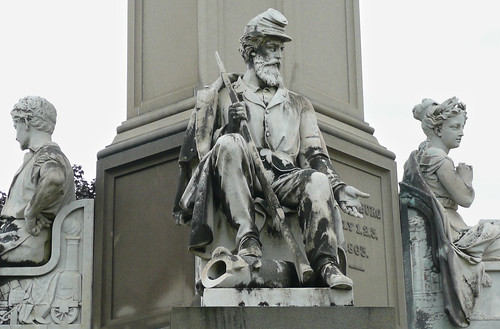
American sculptor Randolph Rogers, who designed the Christopher Columbus doors for the U.S. Capitol, was commission to create a national memorial of sorrow to stand in the center of the cemetery. He placed a statue of Liberty atop the marble monument, and she is holding a sword in one hand and a wreath of peace in the other. It was completed in 1869 with four statues seated around the base to represent the chapters of time – history, war, peace and plenty.

This cemetery is a short walk from the new $135 million Museum and Visitor Center of Gettysburg that opened this year. Go there. The place is outstanding.

Wednesday, September 24, 2008

Donora smog video set to air


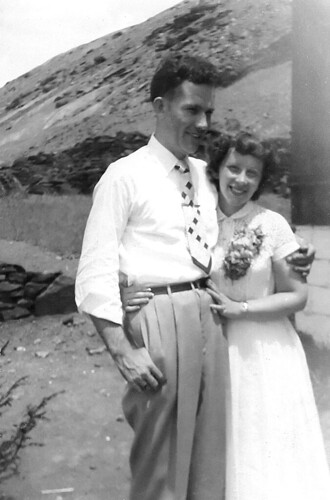
Jim and June Beveridge, originally uploaded by Scott Beveridge.

The Weather Channel is set to air its new documentary about the Donora smog on Sunday, Nov. 2, around the time of the 60th anniversary of the disaster in southwestern Pennsylvania that killed more than 20 people.

I’m expected to make my small-screen debut in the television show, “Killer Smog,” which is part of the network's series, “When Weather Changed History.” My mom, June Hart Beveridge, is a smog survivor who also will tell her story in the show about the nation’s deadliest air pollution event.

“The show looks great,” said Nara Walker, producer of the show for Towers Production in Chicago.

While in Donora to shoot the video in June, Walker recreated a football game between Donora and Monongahela that went on as schedule during the smog even though no one could see the action from the stands because of the thick smoke in the air.

The smog hovered over the borough for three days during a Halloween weekend in 1948, trapping deadly fumes from Donora’s steel and zinc mills in the Monongahela River valley. As many as 1,000 people were sickened and many of them filled the beds at two local hospitals before the fog lifted.

Check local TV listings for the time the show will be broadcast.

Click here for information on the upcoming Donora smog commemoration.

(Caption: June Beveridge is shown with her husband, Jim, posing for this photo about 1950 outside her home in Webster, Pa., where hillsides were stripped of their vegetation by air pollution from the nearby Donora mills.)

Monday, September 22, 2008

Walls that can haunt a skeptic


DELAWARE CITY, Del. – Laura M. Lee is a skeptical park ranger, but she admits to having been spooked on more than one occasion while on the job at an old United States military fort off the coast of Delaware.

She once heard a crash shortly after exiting the mess hall at Fort Delaware, a sturdy stone fortress built in 1859 to protect the ports of Philadelphia, Pa., and Wilmington, Del., and later used to hold Confederate prisoners during the Civil War.

She returned to the dining room to find a portrait of Southern Gen. Leon Jastremski that had fallen to the floor, face down. It was the image of a man who had been tricked into believing he was being set free only to be taken to a Confederate camp that fell soon under fire from Union warships.

“It was the anniversary ... of day the ship sailed out of here,” Lee said, following an August tour through the travel destination that consistently wins award for its outstanding programs. "That was weird."

In one corner of this maze of buildings, her co-worker portrays a Civil War blacksmith turning hooks from blazing-hot metal. Nearby, an actor pretending to be a Union soldier hums a mellow tune with a harmonica while standing guard over a “prisoner” chopping wood. Meanwhile, another employee of the Delaware Department of Natural Resources shows a group of children how troops kept guns clean and ready for fire during America’s war between the states.

At the same time, Lee is discussing another ghostly story about the night she slept in one of the bedrooms and was startled awake by a rocking chair in motion when no one else was in the room.

“They tell a lot of ghost stories around here,” she said.

There is good reason to believe tales of horror at this incredibly intact piece of American military history on Pea Patch Island that supposedly formed around the wreckage of a boat carrying a cargo of peas. The land apparently grew around silt that built up when the pea pods sprouted.

Toward the end of the Civil War, the sprawling island became a brutal home to nearly 40,000 captured soldiers and sailor, where 5,200 of them died, mostly from infectious diseases, Lee said.

Jastremski, though, ended up on Morris Island, South Carolina, after he was tricked into trading his watch to a Union soldier to gain freedom. He found himself at a destination so grotesque that he ended up eating rats to survive. Others wearing his coat of arms escaped Pea Patch through outhouses that drained into the bay to certain deaths in swift tides.

Fort Delaware was destined for a much better fate, as it “never was attacked and never fired a shot in anger,” Lee said. It was modernized in 1896 but soon became obsolete after the military tested its defenses by firing a missile from a friendly attack ship.

“They put a big hole in it,” she said.

And the place would become abandoned by World War I because its walls were forever defenseless against airplanes that drop bombs, she said.

As many as 18,000 visitors now take the short ferryboat ride from Delaware City each year to the island to walk around this amazing fort that survives in great shape despite its age.

They cross the heavy bridge over a moat to the puzzling grounds and wonder how and why the rambling buildings took shape and become eager to explore their dark halls.


(Caption: Rob Williams and Sean Carrow portray a Confederate captured at Gettysburg and Union guard, respective, at Fort Delaware)

(Click here to view a slide show of photos from my visit to the fort)

Tuesday, September 16, 2008

University students hot about smoking ban


CALIFORNIA, Pa. – Editors at the Observer-Reporter periodically send me to California University of Pennsylvania to gather reactions from students about news that could affect their lives.

In many cases, I encounter students who are either unaware or could care less about such things as the declaration of war on Iraq at a time when lawmakers considered reinstating the draft and possibly using them to fill the Army. No one there organized a protest march over that fear.

But don’t take away their right to light up cigarettes at this campus in California, Pa.

Nearly 100 Cal U. students turned out on campus today to oppose a decision to prohibit smoking on the entire campus, even outdoors, under Pennsylvania’s new Clean Indoor Air Act. The law was imposed Thursday, banning smoking in most public places, including bars, restaurants and bingo halls.

The students make a good point when they argue that the decision by the chancellor of the Pennsylvania State System of Higher Education doesn’t make sense because he cites it as reason enough to prohibit smoking altogether at the 14 public universities. Chancellor John Cavanaugh said the schools hold classes and sporting events outdoors, making everything within their confines public places and subject to the new act.

One 24-year-old Cal U. student, Dan John of Uniontown, Pa., who is shown in above photo, complained that the state is assuming too much control over student rights.

Meanwhile, Dalyce Ullom, 19, of Pittsburgh, said her human rights are being violated over the decision.

“How can they tell me not to smoke?” said Ullom, a sophomore at Cal U., where 8,500 students attend classes. “That is legal. If I can buy them, I should be able to smoke them.”

God only knows what could happen in the name of civil unrest if these universities decide to filter out Facebook on their Internet providers.