
Wednesday, June 27, 2007

Havoc on the hill
Click on the photograph to view a promotion for a series of articles that will begin Sunday in the Observer-Reporter about Detroit drug dealers and how they have infiltrated Washington, Pa. (video produced by Harry Funk, online editor at the O-R)

Sunday, June 24, 2007
Trim your beer belly here

The Yough River Trail is the greatest stress reliever that I have found since kicking cigarettes.
Within a few minutes after hitting the hiking and biking path along an abandoned rail line due south of Pittsburgh, my nerves settle into a tunnel of green and all the nature it affords. The quiet is occasionally broken by the exciting shrill of an Amtrak train that follows the rails on the opposite side of the Youghiogheny River.
We are fortunate in Southwestern Pennsylvania to be home to this park, which is part of the Great Allegheny Passage, a 316 mile trail that connects Cumberland, Md., and Pittsburgh. A newcomer should expect adventure, especially in the remote sections. One day, a squirrel fell out of a tree and landed in the spokes of my bicycle’s front tire. He was stunned, but his injuries did not appear to be life threatening. Another time, I had to turn back after scouting a rabid red fox about 50 yards ahead of my handlebars. You also can explore the village of Whitsett, where there are ancient Anica Mine and Coke Works buildings. One is surrounded with poisen ivy and leads to a scary, dangerous portal into the deep mine that should have been sealed a long time ago to keep out the kids.

This place, meanwhile, is home to wildflowers and butterflies in their natural settings rather than in some habitat garden built in a city park.

A dad sporting a mullet can take his son here to bond over some fishing.

You never know, you might even encounter a cowboy out of his element.

But, the best part.....

Thursday, June 21, 2007
The hills are green and gray
The landscape of Southwestern Pennsylvania can be described as a bit schizonphrenic.
On one hand, it offers scenic views of rolling hillsides and pastures like this:

And, there are well manicured gentleman farms hugging country roads.......

Almost out of nowhere appears a giant, contrasting image of the coal industry that, in many ways, drives the local economy. The state Department of Environmental Protection requires coal operators to develop these slurry ponds to recycle water they use to wash coal as it leaves their mines. In grand scale, gray mine waste is built up to create a dam wall to hold back this water and allow sediment to fall to the bottom of the pond before the water goes back to the coal-washing plant.

It's nearly impossible to take in the region's natural resources and not-so-natural resources unless they are viewed from a low-flying airplane. We passed over these areas on a newspaper assignment this week in a Piper aircraft to take a look at the poorly-designed Interstate 70, especially its Bentleyville interchange, portions of which predate World War II. One highway entrance ramp there is heavily traveled by tractor trailers, but the road is too short for even cars to get up enough speed to compete with the ever-increasing traffic. Here's a kooky two-leaf I-70 cloverleaf in nearby Somerset Township:

(Photography copyright: Observer-Reporter)
On one hand, it offers scenic views of rolling hillsides and pastures like this:

And, there are well manicured gentleman farms hugging country roads.......

Almost out of nowhere appears a giant, contrasting image of the coal industry that, in many ways, drives the local economy. The state Department of Environmental Protection requires coal operators to develop these slurry ponds to recycle water they use to wash coal as it leaves their mines. In grand scale, gray mine waste is built up to create a dam wall to hold back this water and allow sediment to fall to the bottom of the pond before the water goes back to the coal-washing plant.

It's nearly impossible to take in the region's natural resources and not-so-natural resources unless they are viewed from a low-flying airplane. We passed over these areas on a newspaper assignment this week in a Piper aircraft to take a look at the poorly-designed Interstate 70, especially its Bentleyville interchange, portions of which predate World War II. One highway entrance ramp there is heavily traveled by tractor trailers, but the road is too short for even cars to get up enough speed to compete with the ever-increasing traffic. Here's a kooky two-leaf I-70 cloverleaf in nearby Somerset Township:

(Photography copyright: Observer-Reporter)
Tuesday, June 19, 2007
Celebrity soldier

By Scott Beveridge
In one letter home from the Civil War, Union Army Capt. David Acheson wrote about seeing President Lincoln sweeping by his camp on horseback to survey the troops.
Another letter from the Washington, Pa., officer made note of women who sneaked to his camp to take a peek at soldiers, and how much he missed their company.
In the last letter home, dated June 28, 1863, five days before he was gunned down at Gettysburg, Acheson informed his parents that he suspected he was heading into the “campaign of the war.”
The soldiers in his command were terribly worn down from marching 23 miles a day north by the time they reached Uniontown, Va., in advance of fighting at Gettysburg. Along the way, they slept in puddles of water, Acheson wrote.
“I never knew what a man was able to endure before,” noted the 22-year-old son of a judge who was among four brothers who served in the war.
Acheson was a charming, naive man who loved gardening, not one who would have enjoyed the limelight, said Ellen Armstrong of West Middletown, Pa., a descendent of the Achesons who inherited some of the soldier’s belongings.
“He was not a show-off,” Armstrong said.
But Acheson has emerged today as somewhat of a local war celebrity through his death and the lengths his comrades went to ensure him a proper burial. He’s been the subject of at least two books, as well as numerous articles in local newspapers.
And, Acheson’s story was featured last month in a WQED
documentary, “Stone Soldiers: Saving the Gettysburg Monuments,” about problems the Gettysburg National Military Park
faces in preserving the many monuments at the 6,000-acre battlefield, including a crude marker bearing his initials.
“There was never more of an unlikely (hero) that you could ever find,” Armstrong said.
At 3:30 a.m. on July, 2, the second day of battle, Pennsylvania’s 140th Regiment, Co. C., was called to arms before Acheson and his men had time to eat breakfast.
The events of the day would be told in a letter written by the unit’s adjutant, William A. Shallenberger, and reprinted in the 1991 book, “Inscription at Gettysburg,” by Sara Gould Walters.
There was a temporary halt to the fighting, allowing the regiment to nap in the afternoon, before it would come to be surrounded by Confederate soldiers. Rebel sharpshooters had taken aim under the cover of large boulders in a line of woods above a wheat field, where the Union troops had settled.
“Tighten your belts, boys, our turn is next,” soldier John Paxton related in another letter from the war and reprinted in Walters’ book. Nearly 500 soldiers followed the 140th into battle, making up the largest regiment in the brigade. Acheson’s unit carried 38 men into the right flank of battle, the most dangerous position and one of honor.
The day had quickly turned dark under heavy smoke from “shells smashing into trees, the rattle of enemy musketry,” Walters wrote.
In no time, Acheson was downed by two shots to the chest in a line of fire released by soldiers from South Carolina. Dead bodies and horses littered the battlefield as the Pennsylvanians retreated in defeat. Of the 38 men with Acheson, seven were killed, 22 suffered injuries and two were captured before more Union troops arrived from the rear and pushed back the rebels.
The following day, Acheson’s friend George Laughlin, went in search of his body. Laughlin, who went on to become a partner in Jones & Laughlin Steel Corp. of Pittsburgh, had to turn back under Confederate fire. He and Acheson were classmates at Washington College before it became known as Washington and Jefferson College.
The identities of the soldiers who buried Acheson in a shallow grave beside a boulder were unknown. Using a nail or other sharp tool, they carved his initials into the rock so that his family would know where to find the body.
“It’s absolutely fascinating,” Armstrong said. “I just became so in love with these people.”
News of the ill-fated battle soon reached Washington County “like a thunder peel from a clear sky,” Waters wrote. After losing a hand in battle, Lt. Isaac Vance of Amity broke the story in a note he sent that contained some of the names of the dead.
“No one was able to stem the current of sorrow ... the village was quiet as a grave, except the outburst of anguish from some broken-hearted mother, wife or friend,” a newspaper reporter noted in an article.
Acheson’s first cousin, A. Todd Baird, and schoolmate James Blaine Wilson had the gruesome task of retrieving the captain’s body 10 days after the battle. Wilson uprooted a geranium from a nearby garden to take home to the fallen man’s father, Washington County Judge A.W. Acheson.
Wilson then sat atop the “rude coffin lined with zinc” in a wagon that carried the party through the night in a steady rain from Gettysburg to Harrisburg. Armstrong said a train likely carried the crew to Pittsburgh, where another wagon finished the trip to Washington.
Baird would fall ill for many days with typhoid fever after walking through the heat and stench in the battlefield that was still piled with decaying horses, Walters noted.
Acheson was reburied July 15 on a soft hill overlooking the Civil War section of Washington Cemetery. An aging white marble tombstone bearing crossed swords marks the grave, which is planted with flowers each spring by a person unknown to Armstrong or her relatives. More people ask for directions to the grave each year than any other in the cemetery.
In Gettysburg, the National Park Service does not draw attention to Acheson’s temporary grave marker, or the many others like it “off the beaten track,” to ward off vandalism, said Katie Lawhon, spokeswoman for the park.
“They are very, very important. They represent such an enormous loss for this country,” Lawhon said. “It’s one isolated example about how important that loss was to them, and then kind of magnify that ....,” she said, adding that 52,000 men were either killed, wounded or captured in the historic battle.
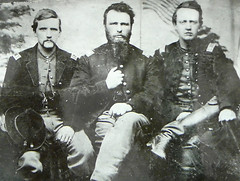
Capt. David Acheson, far right, with his friend, George Laughlin, at left. The other Union soldier was Alexander Sweeney, another member of the 40th.
(This story first appeared in the Observer-Reporter)
Sunday, June 17, 2007
City safari

There is a tireless way to tour downtown Pittsburgh these days, one especially designed for those who are short of breath. Segway in Paradise of Cranberry is offering two hour tours of what it considers to be the most interesting sites of the city aboard self-balancing electric scooters. You can “treat yourself to the glide of your life” while wheeling past PNC Park, Heinz Field and the Cultural District, the company’s Web site indicates. All this excitement without so much as breaking a sweat. People will stop in their tracks and stare, giggle, roll their eyes or turn up their noses at these lazy safari hunters. The hats that come along with the ride are a hoot. For a chuckle, check out the comments on this photograph at my gallery.
Subscribe to:
Posts (Atom)