a newspaper man adjusts his pen

Tuesday, February 22, 2011

A feeshy tale

This $5 find at Black Rose Antiques & Collectibles in Washington Crown Center mall, Washington, Pa., reminded me of my father's funny way of mispronouncing words.

By Scott Beveridge

The origins of my father's hillbilly accent has been an amusing subject for decades.

Jim Beveridge didn't eat fish sandwiches on fish fry Fridays during Lent. He ate "feesh" sandwiches.

And when the Webster, Pa., steelworker wasn't in the mood for bread with cod, he ate his "feesh on a deesh" at home or the annual fire hall fish dinners here in the middle reaches of the Monongahela River Valley, about 30 miles south of Pittsburgh.

His dialect certainly wasn't Pittsburghese. Most of us here seem to know how to correctly pronounce fish, but we have earned a famous reputation for screwing up the plural you, by turning it into "yinz," and also saying "wersh," rather that wash, when its time to do the laundry or redd up the house.

I heard a hint of where my late father learned how to talk like an Appalachian misfit a couple weeks ago while meeting with a Marcellus Shale executive in Washington County, Pa. That guy didn't sound like the Texans who hold many of the jobs around here working in the booming industry, especially when he turned the word, flash, into fleesh.

"I'm from Steubenville," the Ohio man revealed.

Bingo.

My dad spent a good part of his childhood in that Ohio River town during the Great Depression.

A subsequent Google search provided a second source that loosely confirmed that he hadn't learned how to talk like an outsider in these-here parts of the mountains.

The search engine led to an excerpt from a book, "Me and Orson Welles: a novel," by Robert Kaplow, and a passage about the comical way in which Ohioans say, "feesh on a deesh."

Mystery solved.

Monday, February 21, 2011

Going to miss you Babe

Click here to read the Observer-Reporter feature obituary of Thomas Gregg Sypula, 60, of Canton Township, Pa., who died yesterday en route to cover a story.

Click here to view a touching WTAE-TV video about Tommy.

The funeral home obituary:

Thomas Gregg Sypula, 60, of Washington, died unexpectedly Sunday, February 20, 2011, in Canonsburg General Hospital, of an apparent heart attack.  

He was born November 16, 1950, in Tarentum, a son of June L. McAllister Sypula of Natrona Heights and the late Albert Thomas Sypula.


Mr. Sypula was a member of Immaculate Conception Church.  


He graduated from Tarentum High School in 1968. While at Tarentum High School, he was a standout football and baseball player and also played basketball. He then attended Kansas State University prior to enlisting in the U.S. Navy. During his service in the Navy, Mr. Sypula received the National Defense Service Medal. He served on the USS Hornet in 1969, which was the ship that participated in the retrieval of the Apollo 12 Space Capsule.


Mr. Sypula loved photography and videography. He loved being the first man on the scene to cover a news story. Mr. Sypula was a self-employed photographer and videographer providing coverage for several Pittsburgh news stations.  


He was an avid sports fan. From 1989 until 2009, he produced football films for Washington High School and then for Canon-McMillan High School.  


Mr. Sypula enjoyed spending time with his nieces and nephews. He loved his children, Tommy and Sara, and his wife, Charlotte. Mr. Sypula was a devoted family man and a friend to many. 


On June 23, 1979, he married his high school sweetheart, Charlotte Demma ,who survives. 
Also surviving are a daughter, Sara (Rico Dillard) Sypula of Beechview; three brothers, Lynn (Janice) Sypula of Creighton, Kim (Michelle) Sypula of Peters Township and Chuck Sypula of Natrona Heights; a sister-in-law, Rosemary (Gene) Trenski of Freeport; a brother-in-law, Michael (Joan) Demma of Fort Collins, Colo.; and eight nieces and nephews, Gina, Joe, Eric and Kaila Sypula, Jonathan (Ashley) Trenski, Michael Demma, Michelle (Mike) Jones and Kristine (Ray) Medrano. 


In addition to his father, deceased is his son, Tommy M. Sypula. 


Friends will be received from 6 to 8 p.m. Wednesday and 2 to 4 and 6 to 8 p.m. Thursday in Warco-Falvo Funeral Home Inc., Wilson at East Katherine avenues, Washington, S. Timothy Warco, supervisor/director, Susan Falvo Warco, director, S. Timothy Warco II, director. A prayer service will be held at 9 a.m. Friday, February 25, in the funeral home followed by a Mass of Christian Burial at 10 a.m. in Immaculate Conception Church, West Chestnut Street, Washington, with the Rev. William P. Feeney, pastor as celebrant. Burial will follow in Washington Cemetery.


In lieu of flowers, those wishing to make memorial contributions may do so to the Washington High School Scholarship Fund in Memory of Tommy M. Sypula, in care of Charlotte Sypula, 132 Laddie Drive, Washington, PA 15301. Online condolences may be expressed at www.WarcoFalvoFuneralHome.com.

Saturday, February 19, 2011

The finest pure hitter in history


The Donora Historical Society has set aside a section of its museum in the Pennsylvania borough to honor Stan Musial on his being given the Presidential Medal of Freedom, the nation's highest civilian award.

President Barack Obama, when the award was presented Tuesday at the White House, said the Hall-of-Famer is "a gentleman you would want your kids to emulate." 

As another way to honor the 90-year-old Donora native, let's look back to December 1999 and take another look at this story about him that appeared in the Observer-Reporter:

By Matt Jacobs

Before the phrase, "You da man," weaved its way into the fabric of modern pop culture, there was just "The Man."

Stan "The Man" Musial, that is. 

During his 22-year Hall-of-Fame career with the St. Louis Cardinals, Musial, who was born and raised in Donora, was, and perhaps still is, regarded as the finest pure hitter in National League history. 

At times overshadowed by American League stars of the era like Joe DiMaggio and Ted Williams, Musial has the statistics to back up his immortal nickname. 

From the time Musial first broke into the big leagues with the Cardinals in 1941, until his final game in 1963, the three-time National League Most Valuable Player compiled a .331 batting average to go with 475 home runs and 1,951 RBI. Musial finished with 3,630 hits, won seven NL batting titles and was the first Cardinals' player to have his number (6) retired. 

As a member of three World Series champions, Musial frequently saved his best for when it mattered most. All that, despite missing the entire 1945 season while serving the United States in World War II. 

Despite his success at the major league level, Musial never forgot his humble beginnings on the rugged, unforgiving ball fields of Donora. 

"Sixty years ago, I was a batboy for the Donora Zinc Works (a semipro team)," said Musial in 1996 during a dedication ceremony for Stan "The Man" Musial Baseball Field.

"My neighbor, Joe Barbao, took me under his wing. He tutored me and we played baseball all the time. One day when we were playing, the regular pitcher didn't show up. So Joe put me in to pitch. 

"Well, I struck out something like 15 guys in six innings. Of course, that was quite a feat because I was only about 14 at that time. After that game, they voted me into their association so I could play. It was terrific experience because I was playing against fellows who were 18, 19 and 20 years old." 

While Musial frequently returns to his old stomping grounds, the field dedication held special meaning. 

"I want these fields to be a symbol and an inspiration to all the young ballplayers," said Musial, who was born November 21, 1920, to Lukasz and Mary Musial. "Somewhere along the line, something like what happened to me could happen to them."

Musial also met his wife of nearly 60 years, the former Lil Labash, in Donora. 

"I remember when I was about 14," Mrs. Musial recalled. "I was at a baseball game and everyone kept telling me to look at the little Polish kid. Well, I wasn't interested in boys at that age. But the following year, I met Stan at 15 and everybody told me he was the Polish kid who played baseball. I knew it was Stan." 

The couple has four grown children, 10 grandchildren and two great-grandchildren. 

Musial, who was voted into baseball's Hall of Fame in 1969, runs Stan "The Man" Inc., a St. Louis firm that deals in memorabilia from his baseball career. 

He remains as humble as ever. Musial never wanted to be DiMaggio or Williams. He's quite content just being "The Man." 

"I played on this field 60 years ago – 60 years ago, that's hard to believe," he said at the ceremony. "I'll tell you, I'd rather have a bat in my hands than a mike. I knew what I was doing with a bat."

Wednesday, February 16, 2011

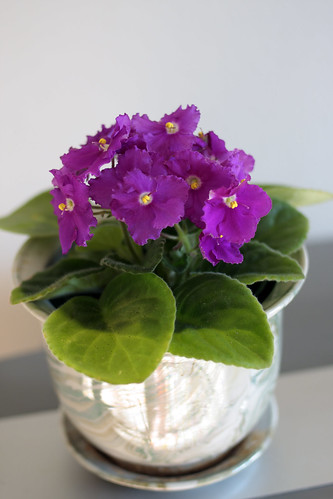
The tricks to growing African violets


African Violet, originally uploaded by Edward Kaye.

By Terri T. Johnson

Growing an African violet is not difficult. Just find a sunny, preferably east-facing window and place the plant on the windowsill.

Native to humid areas, an African violet likes humidity so a kitchen
window above the sink can be ideal.

Known officially as Santpaulia, the plant is actually a genus of six
species of herbaceous perennial flowering plants native to Tanzania and to neighboring southeast Kenya. Hence, African violet.

The vibrant green, fine-haired leaves provide a stark contrast to the soft white, pink or violet flowers that grow in clusters near the center of the plant.

The showy plant does require some work, like proper watering,
fertilizing and exposure to light, but it’s nothing even the most inept
gardener can’t handle.

There are several ways to obtain an African violet, the most common
being to buy one, usually at a supermarket, home improvement or
discount-type store or a nursery.

Another way is to find a friend or family member who grows the violet
and take a leaf cutting. Some recommend dipping the cutting in a
special solution, but an easier, and less expensive way, is to simply
place the cut leaf in a small vase with water.

A clear shot glass or small juice glass is an excellent way to start the leaf to root.

Do not allow the water to touch the actual leaf. Just submerge the
stem. Place the glass in an area where it won’t be disturbed and watch for the roots to form. Once the root system is established, plant the leaf and watch the plant take shape. This method takes longer than simply buying a plant, but it is less expensive.

For those who buy a plant, the experts recommend repotting it almost
immediately. Clay or plastic pots are fine, but make certain there are
drainage holes-one hole is acceptable-and place a pebble on each
drainage hole.

Fill the pot about halfway with African violet soil, place the plant in
the middle and fill the remainder of the pot with soil. A teaspoon
works well to add the soil without damaging the actual plant. Tamp down the soil and add more if necessary.

Always place any African violet pot in a saucer and then fill the
saucer with tepid water and let sit for about an hour. Take the pot out
of the saucer and empty any remaining water and return the saucer to
under the pot.

Light is important, that’s why an east window is good, but a
north-facing window will also work.

If the plant doesn’t flower, it’s probably not getting sufficient
light, and if the leaves develop brown edges or brown spots, it’s
getting too much light. Pay attention to the plant. It will let you
know when it’s not happy.

Water is also vital. Never, never water an African violet from above
leaving wet spots on the leaves. And never, never use cold water. Fill
a watering can and let it sit, maybe for several days to allow the
water to reach room temperature and for the additives, like chlorine
and fluorides, to evaporate.

One way to test if an African violet needs to be watered is to stick
your finger in the soil. If the soil sticks to your finger and feels
damp, don’t water. If the soil does not stick, it’s probably a good
time to add a little water from a watering can with a small spout
directly on the soil.

Once the flowers are through blooming, like with any plant, deadhead it by gently cutting or pinching off the dead blooms.

Growing African violets is relatively easy but fungal, bacterial and
viral diseases can strike, and the plant can become home to certain
parasites.

Don’t panic, just keep the plant happy with the correct
amount of light and water, with a little fertilizer thrown in and
beautiful flowers will be the reward.

Terri T. Johnson is a staff writer at The Almanac weekly newspaper in McMurray, Pa. This column first appeared in its Suburban Living magazine's February/March edition.

Sunday, February 13, 2011

Pass the meaty marshmallows, please

Gourmet offerings from Pittsburgh Marshmallow Factory, not of the vegan variety. (Scott Beveridge photo)

By Scott Beveridge

PITTSBURGH – The conversation with the gourmet marshmallow saleswoman went like this:

"So what exactly is a vegan marshmallow?" I asked her at Pittsburgh Public Market, a great new place where local food producers sell their goods in the city's Strip District.

"It's made without any animal products," responds this cook at Pittsburgh Marshmallow Factory.

I visited this market curious about a Tweet from this start-up company that it had manufactured a marshmallow for vegetarians, while wondering which meat traditionally went into the making of this fluffy and gooey candy.

So I first called a friend, a scientist with a background in laboratory work for her opinion.

"Here's the story:" she said. Marshmallows are concocted with gelatin made from bones, tissues and sometimes intestines of domesticated farm animals, she thought. The vegetarian recipe calls for the gelatin to be replaced by agar-agar, a gelling agent made from sea weed on which lab workers grow bacteria, she adds. (Yuck on both accounts)

"Are vegetarians that particular when it comes to eating marshmallows?" I ask the woman selling them Saturday in Pittsburgh.

"Oh yes," she answers. "They have been asking for them ever since we opened."

"What flavor do they come in?" is the next question out of my mouth.

"Just vanilla," she said.

That was not appealing when before me were animal-based marshmallows in flavors including chocolate, mint and Orange Creamsicle.

Tiny samples on the table at this Smallman Street market proved this company knows how to make top shelf marshmallows, which are about the size of 2-inch squares and sell for a buck apiece.

There even is a marshmallow here made with hot peppers, and word has it, this company owned by Debbie Steinberg and Chris Momberger of Creighton have flavored others with bacon.

I decided to buy an assortment of non-vegan marshmallows before heading over the South Side for a cheeseburger at Birmingham Bridge Tavern.

Saturday, February 12, 2011

Storied newspaper championed civil rights

A display of a Ku Klux Klan hood and robe from the 1940s near the entrance to an exhibit on the 100th anniversary of the Courier weekly newspaper. (Scott Beveridge photo)

By Scott Beveridge

The robed dummy dressed as a member of the Ku Klux Klan is alarming at the entrance to a Pittsburgh museum holding a special tribute to a celebrated black newspaper.

Worse yet, upon closer examination, the hooded costume supposedly worn by a Beaver County steelworker appears to be walking on copies of The Pittsburgh Courier, the weekly being honored on its 100th anniversary at the Senator John Heinz Regional History Center.


The display reveals there once were nine klaverns in Beaver County in 1920, and that the hooded robe behind the glass case likely had been worn by Earl Long of Hopewell, who worked at Jones & Laughlin Steel Corp. in Aliquippa. It's here as a reminder that the newspaper had mounted an anti-Klan campaign as a crusader of America's Civil Rights Movement.


It’s unfathomable to fully comprehend the fear The Pittsburgh Courier’s reporters had to have faced in unraveling their stories when racism was rampant. The job, today, is challenging enough for a white reporter like myself, especially when it comes to dealing with uncooperative police and court officials or politicians who avoid answering questions and then attempt to intimidate you once they are cornered.


Founded by poet Edward Nathanial Harleston in 1910, the newspaper went on to be regarded at the most-widely circulated and best black weekly newspaper in the United States.


Among its more famous journalists were photographer Charles "One Shot Teenie" Harris, who covered President John F. Kennedy's 1962 tour of Pittsburgh, and reporter George Barbour, a winner of 6 Golden Quill Awards for exposing racist hiring practices in Pittsburgh and Allegheny County.


Pittsburgh was "fertile ground for a newspaper" to report on the challenges of the black community in the early 1900s, when blacks in growing numbers relocated to Pittsburgh from the South for work and freedom, the exhibit states. The Great Migration saw the black population rise in the county from 34,217 to 83,326 by 1930.


Yet this newspaper didn't just report on racial problems in the city. It dispatched reporters to wherever there were major problems, and even exposed deep-seated racism in the South when nine young black teens nicknamed the Scottsboro Boys were falsely accused of gang raping two white girls on a train in 1931.


Meanwhile, I had the privilege of interviewing Barbour 14 years ago for a Black History Month feature story in the Observer-Reporter. The Bridgeville man was heralded by Variety as having been the "first full-time Negro broadcast journalist on a major Pittsburgh broadcasting station" after he was hired by KDKA to expose discrimination in the local housing market.


"I got thrown out of a tavern in East Liberty and denied buying a home in a number of areas," the then-71-year-old Barbour said.


Management told him he was doing a wonderful job.


"But when I looked around KDKA, I didn't see any black faces. I was waiting for them to say they wanted to hire me," he said.


He went on to say that young children need to know their history, regardless of their race.


"There isn't one person in this country whose ancestors haven't experienced racism, hatred. America has a long way to go to become mature."


Barbour could possibly have once sat behind the antiquated green steel desk and old manual typewriter in a display near the end of the exhibit, where visitors are reminded of the challenges newspapers have faced in recent years over declining circulation and competition from the Internet.


The display ends with hope because The New Pittsburgh Courier and its online reports, including those on Twitter and Facebook, give it a bigger voice in one day than "it did in a month at its height in the 1940s."


It will run through at least the end of the summer at the museum at 1212 Smallman St.


The colored waiting room in Union Terminal, Pittsburgh, early 1900s, shown at the entrance to the exhibit.