a newspaper man adjusts his pen
Tuesday, November 23, 2010
The village of Webster before steel killed its dreams
WEBSTER, Pa. – Few people in my hometown of Webster, Pa., could relate to stories told by local old timers about their memories of the village when it was beautiful before America's Industrial Revolution turned it into an environmental disaster zone.
Well the photograph, above, recently discovered at the nearby Donora Historical Society has finally vindicated those folks who remembered the small southwestern Pennsylvania village along the Monongahela River in its heyday. Their memories were drawn from an era predating the strength of US Steel, which, in 1901, expanded a sprawling steel mill and later built zinc smelters across the Mon in Donora, creating pollution that killed most of the vegetation in Webster and contributed to the infamous smog of 1948.
The photo was taken when residents of the village had planted lush gardens behind clean picket fences, as well as a new Presbyterian church next to a Victorian apartment building. They had big dreams and houses by the river where their children could walk to its shores for a swim. Tree shade was abundant.
Click here to view a larger version of the photo. Click here to read a story written in 1908 by a Webster woman about the history of the town.
(Allow me a day or two to take a photo from a similar vantage point of how things look here today)
Saturday, November 20, 2010
A keepsake calendar of the old Mon
CALIFORNIA, Pa. – Nowhere in the Monongahela River Valley is there a more-beautiful vista than from High Point, which overlooks the small southwestern Pennsylvania towns of California and Newell.
It's no wonder the California Area Historical Society chose the old photo, above, to the promote sales of its 2011 calendar. The 19th century image shows half of a horseshoe bend on the Mon, when its hillsides were dominated by farms, and two steamboats provided a hint of what would become of America's Industrial Revolution that forever changed Pittsburgh-area riverbanks.
The calendar features a dozen other frame-worthy photos, including: a saw mill along Lilley Run; coal miners' houses in nearby Daisytown; and Lewis Morgan's first general store in California.
The fundraiser supports the society's museum and genealogy center in an historic house at 429 Wood St. For information, call 724-938-3250.
Wednesday, November 17, 2010
A display of faith
A visitor pauses before a reproduction of Michelangelo's 1499 Pieta on display at Sen. John Heinz Regional History Center, Pittsburgh (Scott Beveridge photo)
By Scott Beveridge
PITTSBURGH – Artists debated for 20 minutes about how to cast a plaster mold of Pope John Paul II’s hand without dirtying it before his death.
They discussed slipping a thin plastic or light cotton glove over his right hand before slipping it into wet plaster until the pope intervened, said Monsignor Roberto Zagnoli, curator of the “Vatican Splendors: A Journey through Faith and Art” traveling exhibit at Sen. John Heinz History Center, Pittsburgh.
“He said, ‘I might be old, but I still know how to wash my hands by myself,’” said Zagnoli, who also is Vatican curator.
The October 2002 bronze cast of the pope’s hand is one of the most special artifacts in the display, Zagnoli said, and the last thing visitors see after touring the exhibit of items collected over the centuries by Roman Catholic popes. It’s also the only artifact visitors are permitted to touch among the more than 270 rare works of art and other objects in the exhibit.
“He said, ‘I might be old, but I still know how to wash my hands by myself,’” said Zagnoli, who also is Vatican curator.
The October 2002 bronze cast of the pope’s hand is one of the most special artifacts in the display, Zagnoli said, and the last thing visitors see after touring the exhibit of items collected over the centuries by Roman Catholic popes. It’s also the only artifact visitors are permitted to touch among the more than 270 rare works of art and other objects in the exhibit.
The collection, which includes the works of Michelangelo, Bernini and Guercino, is designed to tell the story of Christianity, faith and Jesus over the past 2,000 years. Also on display is a shrine containing the remains of Saints Peter and Paul that has never before left the Vatican.
“I think people will be making pilgrimages here over the holiday season,” said Andy Masich, president and chief executive officer of the History Center.
The tour begins at a walkway to the “tomb of St. Peter,” where objects are displayed that were left behind at his burial site in Rome. The ancient basilica would later be built around the tomb.
“The shrine soon became a place of public worship,” said the Rev. Charles Hilken of St. Mary’s College of California, Moraga, Calif.
Also on display is a crude sixth-or seventh-century reproduction of a gold votive plaque bearing a cross and two large eyes that had been placed on the tomb. Nearby is a cast of a sarcophagus sculpture of Mary holding her child to be venerated by the Wise Men of the East bearing gifts.
“The Roman style of art becomes Christian,” said Hilken, while leading a group of writers through the exhibit before it opened.
A mosaic of St. Peter dating to about 700 hangs from an opposing wall, showing him in the Byzantine style of art with a white beard and hair. He also is depicted with three fingers raised to symbolize the Trinity, Hilken said.
The mood switches to about 1506, when the church began construction of the new basilica, of which Michelangelo was among the architects involved in the building of the shrine over the course of a century.
The focal point here is an exact replica of the artist’s Pieta, a sculpture completed in 1499 showing Mary at the same age as her son, Jesus, when his body was lowered from a cross into her arms.
“It’s the only piece Michelangelo signed,” Hilken said.
The exhibit also includes art showing Christ as Korean, Vietnamese and Chinese as the popes’ taste for art evolved and the church expanded across the globe in the 13th century.
Further ahead is a room lined with large paintings of various popes completed in the 20th century by unidentified Franciscan nuns.
Around the corner Pope John Paul’s portrait hangs above the display of the cast of his right hand, extended as if about to shake the hands of visitors.
The exhibit at 1212 Smallman St. is open daily from 10 a.m. to 5 p.m. through Jan. 9. The exhibit will be closed Thanksgiving, and Christmas Day, and open New Year’s Day.
A crude 6th or 7th century reproduction of a gold votive plaque bearing a cross and two large human eyes that had been placed on the tomb of St. Peter.
(This article first appeared in Living Washington County Nov./Dec. 2010 issue, a publication of the Observer-Reporter.)
Sunday, November 14, 2010
The search for US Colored Troops' graves
Jeff Burton of Rankin, Pa., dressed as a Union Army officer from Pittsburgh, goes in search today of the forgotten graves of black men who served in the Civil War and were buried in Allegheny Cemetery. Please scroll down to watch a short video of a re-enactment by the Soldiers and Sailors Museum Drum an Bugle Corps. (Scott Beveridge photo)
By Scott Beveridge
PITTSBURGH, Pa. – Many children of America's Southern slaves were born free blacks before the Civil War, and surprisingly, some grew to volunteer on the side of the Confederacy, a Pittsburgh historian said today.
Those men needed to protect their jobs in a slave-dependent economy as blacksmiths, carpenters, miners and boatmen when the war to end slavery broke out in 1861, said John Brewer, a member of Sen. John Heinz Regional History Center's black advisory council.
"The Confederate negro served on the other side of the mountain," Brewer said at a service to find and honor the graves in historic Allegheny Cemetery of black veterans who served in the war between the states.
It was a dilemma faced by those southern blacks because their "whole world turned upside down" and they needed to make choices for self preservation, Brewer said.
It's possible a number of them relocated to Pittsburgh after President Abraham Lincoln freed the slaves. No doubt some of those black men were also buried in since-forgotten graves in this, the sixth oldest rural cemetery in the United States.
The history center joined with local black veterans groups in a wreath-laying ceremony in the 166-year-old cemetery as part of Pennsylvania-wide efforts to mark the 150th anniversary of the state's role in the war.
Many famous people also were buried in this cemetery once visited by President Ulysses S. Grant, who sat among the Civil War graves and wept, said Andy Masich, the history center's president and chief executive officer.
Industrialists and many Pittsburgh mayors were buried here, as was the godfather of pop music otherwise known as Stephen Foster.
But, the time has come to "honor the forgotten people" who were buried here," Masich said.
This event grew out of efforts by the history center and Pennsylvania's Department of Community and Economic Development and Quest For Freedom project to hold a series of ceremonies over the next four years to mark the war's anniversary, he said.
"The unrecognized role of African American soldiers during the war is an important thing for us to remember," Masich added.
Major Martin Delany was the best-known black veteran of the Civil War to have been buried in the cemetery. Delany was superintendent of the Underground Railroad's western route through Pittsburgh to Canada, and the highest ranking black officer in the war, said Jeff Burton of Rankin, who portrayed the veteran at the service.
It was a challenge for volunteers at the event to locate and mark the 132 graves of known black Civil War veterans who were buried there because so many names had been smoothed over on the small, flat tombstones, Burton said.
While this cemetery at 4734 Butler St. has been well maintained, nearly 100,000 other unmarked, abandoned burial grounds holding the graves of black Civil War veterans have been documented in the United States, said Marlene Bransom of Greene County, a member of the African American Genealogical Society.
Bransom urged members of the small crowed gathered before the massive stone 1937 war memorial overlooking the veterans' graves to get involved in efforts to locate such lost graves to preserve black heritage.
"As historians and preservationists we must not allow this to continue ... so they will know who, what and where we came from," she said.
It's possible a number of them relocated to Pittsburgh after President Abraham Lincoln freed the slaves. No doubt some of those black men were also buried in since-forgotten graves in this, the sixth oldest rural cemetery in the United States.
The history center joined with local black veterans groups in a wreath-laying ceremony in the 166-year-old cemetery as part of Pennsylvania-wide efforts to mark the 150th anniversary of the state's role in the war.
Many famous people also were buried in this cemetery once visited by President Ulysses S. Grant, who sat among the Civil War graves and wept, said Andy Masich, the history center's president and chief executive officer.
Industrialists and many Pittsburgh mayors were buried here, as was the godfather of pop music otherwise known as Stephen Foster.
But, the time has come to "honor the forgotten people" who were buried here," Masich said.
This event grew out of efforts by the history center and Pennsylvania's Department of Community and Economic Development and Quest For Freedom project to hold a series of ceremonies over the next four years to mark the war's anniversary, he said.
"The unrecognized role of African American soldiers during the war is an important thing for us to remember," Masich added.
Major Martin Delany was the best-known black veteran of the Civil War to have been buried in the cemetery. Delany was superintendent of the Underground Railroad's western route through Pittsburgh to Canada, and the highest ranking black officer in the war, said Jeff Burton of Rankin, who portrayed the veteran at the service.
It was a challenge for volunteers at the event to locate and mark the 132 graves of known black Civil War veterans who were buried there because so many names had been smoothed over on the small, flat tombstones, Burton said.
While this cemetery at 4734 Butler St. has been well maintained, nearly 100,000 other unmarked, abandoned burial grounds holding the graves of black Civil War veterans have been documented in the United States, said Marlene Bransom of Greene County, a member of the African American Genealogical Society.
Bransom urged members of the small crowed gathered before the massive stone 1937 war memorial overlooking the veterans' graves to get involved in efforts to locate such lost graves to preserve black heritage.
"As historians and preservationists we must not allow this to continue ... so they will know who, what and where we came from," she said.
Thursday, November 11, 2010
Greeting her admirers on Veterans Day
May Brock, a member of the American Gold Star Mothers, appears today in the Washington County Veterans Day parade in Charleroi, Pa. (Scott Beveridge/Observer-Reporter)
By Scott Beveridge
CHARLEROI, Pa. – May Brock looks a bit like a star of the silver screen as she rides today in a pickup truck bed in the Washington County Veterans Day parade.
Brock's gold-trimmed hat, long white hair, white pant suit, matching gloves and shoes and big dark sunglasses give her the look of an actress. However, she earns her star status for something that is far from glamerous.
The 88-year-old Washington, Pa., woman is featured in the Charleroi parade because her son, Glenn Smith, died in the Korean War. She belongs to the American Gold Star Mothers organization, whose members lost sons or daughters in battle and appear around the country wearing white at memorial events.
Brock brought with her a small plastic replica of Mount Rushmore mounted on an old metal high chair.
"What is that?" I ask between attempts to take her photo for the Observer-Reporter newspaper on a beautiful autumn day as the sun casts long shadows.
"Look," she says, before pressing a red button at the base of the toy, prompting it to play a patriotic song, the melody of which is drowned out by people loudly cheering her along the parade route on McKean Avenue.
"I think they like you," I say.
"I think they do," she replies, wearing a broad smile.
Tuesday, November 9, 2010
Welcome home

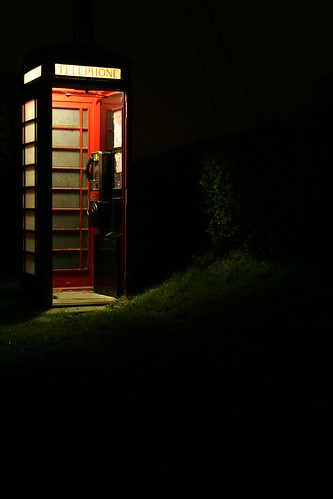
Phone Box, originally uploaded by [Nocturne].
By Ryan Mooney
The phone rings.
Once.
Twice.
No answer.
Still nothing on the third and I begin to feel the panic rise through my stomach into my throat. It rings a fourth time and the knot swells.
Shit, she’s not home, I’m thinking, then…
“Hello,” she says. Two syllables, so simple, so real, so American. My knees buckle, I catch myself.
“Hey baby,” I say.
With each step the sidewalk, it lengthens and a few hundred feet feels like a few million miles.
“Hey you! How are you?” the tenor, the love, it resonates through my heart, shaking me to my very foundation.
“I’m good. It’s hotter than hell here, though," my voice cracks like puberty, "and I miss you.”
“I miss you too," she says, " What time is it there?” It’s beyond cute how she always asks this.
“It’s O’ three hundred hours.”
“Three O’clock," I can feel the dam holding me back beginning to crack, the river beginning to brim, "Ha! I’m getting good!” she says.
I laugh, almost cry at this, thinking, Jesus, I am so crazy in love with you.
“How’s my baby doing?” I ask taking the first step onto the porch.
“Great. I saw there was heavy fighting in Pakistan. Are you still stationed there?”
The front door is larger than I remember. A dark stained oak with a flowered wreath hanging from a nail. This wasn’t here two years ago.
Step two onto the porch.
I notice the faded paint; chipped away from two years of weather and I find it unbelievably refreshing.
“No. Amer-," I slip up, waiting for her to recognize the waver in my voice, "-Afghanistan. It’s North of Pakistan.” My heart is drumming loud in my ears. I swear a boxer is in there trying to uppercut his way out.
“Oh good”, she says, “I was worried.”
Step three.
I pull a small velvet box from my pocket, open it and a small rainbow casts itself across the siding of the house.
“It’s ok,” I say, “Nothing to worry about.” Looking at the diamond, the spectrum fractured into millions of pieces colors the drab browns and tans of my fatigues, I forget that the door I'm standing in front of is part of my home.
I pick a weed from between the cracks of the porch; American soil, so beautiful, so free. Nostalgia coursing through me like a broken faucet.
I ring the doorbell.
“Oh shit. Someone’s at the door.” she tells me, unaware.
The heavy drumming, it continues and I’m dizzy with nerves. Trembling, my vision blurs and a wetness forms in the corners of my eyes.
An eternity.
I lower myself. The reflection in the storm door reveals a man with fuzz covering his face, blue eyes set against a faux-vacation tan and all I can think is, I really should have shaved.
An eon.
This is how long it feels before the door...
It swings open.
I’m on one knee.
Car bombs, land mines, gunfire. The total and utter silence of walking into an abandoned building, weapons trained on nothing, eyes focused on everything and brain expecting anything, is nothing compared to the nerves surging through me right now.
And then, she’s there.
My porch, my house, my yard, my country; it's all miniscule compared to her brilliance.
The phone drops. Plastic and wire scatter into the foyer.
The box drops. Velvet and diamond scatter across the porch.
American flags, Crackerjacks and Ford's. Apple pie and baseball.
American.
Standing just beyond the storm door she’s wearing an old shirt of mine. It’s too big and lazy on her, but it doesn’t matter. Her brown hair is now a fake red. And it, too, doesn’t matter.
I gasp and forget what I’m about to say. It still doesn’t matter though, because look at her. Jesus, take a good, hard look at her.
She's gorgeous.
She is my Americana.
I remember.
“Will you marry me?” I ask.
A smile.
A tear. A flow of tears.
She gasps.
“Oh my God!” she exclaims, throwing open the door, “yes!”
I faint.
Welcome home...
Subscribe to:
Posts (Atom)


