a newspaper man adjusts his pen

Tuesday, September 16, 2008

University students hot about smoking ban


CALIFORNIA, Pa. – Editors at the Observer-Reporter periodically send me to California University of Pennsylvania to gather reactions from students about news that could affect their lives.

In many cases, I encounter students who are either unaware or could care less about such things as the declaration of war on Iraq at a time when lawmakers considered reinstating the draft and possibly using them to fill the Army. No one there organized a protest march over that fear.

But don’t take away their right to light up cigarettes at this campus in California, Pa.

Nearly 100 Cal U. students turned out on campus today to oppose a decision to prohibit smoking on the entire campus, even outdoors, under Pennsylvania’s new Clean Indoor Air Act. The law was imposed Thursday, banning smoking in most public places, including bars, restaurants and bingo halls.

The students make a good point when they argue that the decision by the chancellor of the Pennsylvania State System of Higher Education doesn’t make sense because he cites it as reason enough to prohibit smoking altogether at the 14 public universities. Chancellor John Cavanaugh said the schools hold classes and sporting events outdoors, making everything within their confines public places and subject to the new act.

One 24-year-old Cal U. student, Dan John of Uniontown, Pa., who is shown in above photo, complained that the state is assuming too much control over student rights.

Meanwhile, Dalyce Ullom, 19, of Pittsburgh, said her human rights are being violated over the decision.

“How can they tell me not to smoke?” said Ullom, a sophomore at Cal U., where 8,500 students attend classes. “That is legal. If I can buy them, I should be able to smoke them.”

God only knows what could happen in the name of civil unrest if these universities decide to filter out Facebook on their Internet providers.

Monday, September 15, 2008

The Church of the Turnpike


NEW BALTIMORE, Pa. – There is one exit from the Pennsylvania Turnpike where the tolls collected from drivers are routed to heaven.

Tucked into the side of a steep hill hugging the berm east of Somerset, Pa., is a flight of steps to St. John the Baptist Roman Catholic Church in the village of New Baltimore.

“It’s certainly the only place of its kind along the turnpike and might well be the only of its kind in the United States,” Pennsylvania Turnpike Commission spokesman Joe Agnello said.

Motorists do pull off the toll road at mile marker 129 and climb one of two sets of stairs to attend Mass or simply reflect in the historic church, he said.

The stairways are part of a deal reached 70 years ago when the highway opened and cut a path that split the town in two.

“The church wanted that setup so people could continue to get to church. Today, they would never allow this … but it was grandfathered in,” Agnello said.

At one time, monks were cloistered at the church that had been built on purpose in a peaceful remote area before the highway brought a steady stream of noisy tractor-trailers buzzing past its front doors. The town founded in the late 1700s is now home to fewer than 200 residents.

The stairs, however, are supposed to be demolished under a plan to modernize the highway section, beginning in 2009. The church is hoping that the commission changes its mind about them, and is collecting signatures on a petition opposing the move, the Daily Republican of Somerset reported in 2007.

To demolish the roadside stairways would be a shame, especially for curious fresh-faced drivers who might want to take a moment to explore "The Church of the Turnpike," whose doors are open to visitors during the day. At 101 Finley St., it has an 84-foot clock tower and steeple and a beautiful sanctuary hidden. Once inside, the rumble on the highway is silenced with the help of a row of tall pine trees that shield the redbrick building from the traffic.

Thursday, September 11, 2008

A pause of silence for Flight 93


By Michael Jones

SHANKSVILLE, Pa. – The wind whipping through this abandoned strip mine is the loudest sound that can be heard at a solemn memorial that symbolizes American perseverance. It was at this site seven years ago that 40 men and women died while some of them attempted to take back Flight 93 from four hijackers hell-bent on crashing the airliner into a target in Washington D.C.

People leave a litany of personal items in the 40-foot chain link fence located on a small slab about a quarter-mile from the crash site. Flags, patches, baseball caps, toys and notes are left to the heroes of that flight. Many of the items don’t necessarily have anything to do with the tragic day. But slowly walking past them, I get the sense that they represent us as a people and a country. I see myself in each of the items left behind in Shanksville, Pa.

The story, told by dedicated volunteers, also is amazing. The passengers learned of the attacks on the World Trade Center towers and Pentagon and decided to act. They would not be defeated. But even that isn’t the most astonishing part of this simple memorial.

It’s the silence.

No one says a word. Besides that roaring wind on top of Skyline Road, is the periodic crunching of gravel in the nearby parking lot. No one says a word. The tempered voices of the volunteers can be heard as the visitors listen intently. No one says a word. This hallowed site is too peaceful to be disturbed by screaming children or rude adults. Everyone who enters that modest memorial understands the importance the passengers and crew members played in fighting back. It is one of the many inspiring stories from that terrible day. On this hilly strip mine in rural Somerset County, the emotions can become overwhelming.

And no one says a word.

Click here to watch a video writer Michael Jones brought back from Shanksville.

(Photo and story: Michael Jones)

Monday, September 8, 2008

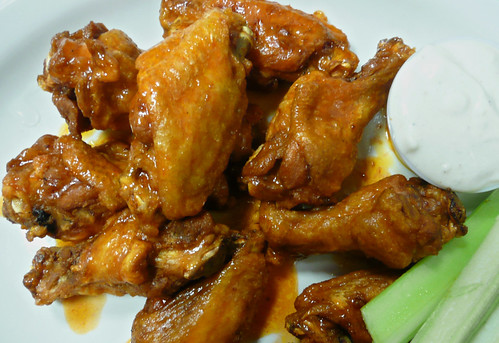
These Buffalo wings are the real McCoy


The real McCoy, originally uploaded by Scott Beveridge.

BUFFALO, NY – The lanky guy serving food and drink at Anchor Bar in western New York has a telephone just for calls to the kitchen.

While pizza, soups and salads are on the menu, the server in need of a personality mostly uses it to bark orders for Buffalo chicken wings at this blue-collar restaurant, where the recipe was born, they say.

The eclectic décor includes license plates from all points in the United States tacked to the walls beside photographs of celebrities who have come here for red hot wings. Above my seat at the aging bar, an old child’s sled and some dusty tennis rackets hang from the ceiling.

The tale about these particular wings is famous, having been told enough times to draw steady crowds through the doors of this redbrick building that faces Main Street. For anyone who hasn’t heard it, here goes:

On a Friday night in 1964, Dominic Bellissimo was tending bar when a group of his friends with ravenous appetites came calling. He asked his mother, Teressa, to prepare something to eat for them.

Out she brought chicken wings, something that had usually gone into the stockpot for soup.

Teressa, though, deep fried those wings and flavored them with a secret sauce. They were an instant hit and it didn't take long for people to hear about them and flock to the bar to experience that new taste sensation. From then on, Buffalo wings became a regular part of the menu.

Although many cooks have tried to duplicate the sauce, the closely guarded secret recipe has helped to put this place on the map, the bar claims.

While the origin of this dish has since been questioned, maybe unfairly, there is no doubt that Buffalo wings have found homes in restaurants from Hot Springs, Ark., to possibly even Death Valley, Calif.

Anchor Bar claims to have sold a whopping 246.8 million pounds of them to its adoring fans.

Its sauce is now imported to Japan, where it became a hit with youngsters while mature people have deemed it to be awful, The Associated Press has reported.

Once inside the bar in late July, I order 10 medium hot wings for $10 after driving around the block in search of a parking spot in this run-down section of the city on the eastern bank of Lake Erie. Windows down, a not-so-pleasant and strong aroma of chicken cooking in hot oil nearly turns my stomach, but it does nothing to force me back.

Later, my wings arrive sticky and steaming beside a few sticks of celery and blue cheese salad dressing, the same way they are always prepared. To my slight surprise, they are delicious, better than any of the many hot wings I have tried back home in Pittsburgh.

And there actually is a recipe behind this sauce, which is nothing akin to the Pittsburgh version of Tabasco stirred with melted butter. I'm suddenly and forever bored by Pittsburgh's Buffalo wings. The Anchor bar variety contains select amounts of vinegar, garlic and cayenne and chili pepper, a gourmet blend that puts it over the top.


Bottles of sauce are sold on the Internet, as well as from the bar’s gift shop. On my approach to this store, a young and rather bored woman appears behind the counter surrounded by T-shirts and large blobs of wrinkly orange rubber that she identifies as hats for wearing at professional home football games starring the Buffalo Bills. (The hats are ugly yet not quite as funny those cheeseheads that crown people in Wisconsin).

I'm disappointed to find the clerk to be clueless about the almost-holy sauce that helps to guarantee her a job.

“I have no idea. I wasn’t born then,” she said, responding to my query about the sauce’s arrival on this planet. That was enough to send me out the door after paying my tab, only to free up a parking space for someone else in the line of cars turning into the joint.

Before leaving, though, I buy a few bottles of the sauce and eventually give one to my neighbor, who never seems to get enough Buffalo wings, the hotter, the better. Later, he said, “That’s good stuff.”

He is undoubtedly scouring the Web as we speak to purchase more Anchor Bar sauce to feed his better-refined habit.

Thursday, September 4, 2008

The gamble on Donora steel


The lighted smelters inside the Donora zinc works, circa 1915. (Photo courtesy of the Donora Historical Society)


Part V: Big promises and pipe dreams


By Scott Beveridge


The infamous and deadly 1948 Donora smog forever be linked to a dirty zinc mill in the Pennsylvania borough became a taboo subject for decades around local dinner tables and town gatherings


Yet it would long remain a popular subject of discussion among researchers.


Scientists now suspect that emissions containing fluoride and unknown metal dusts from the U.S. Steel plant strongly contributed to the fog that killed at least 20 people, giving the borough the distinction of being home to the nation’s deadliest air pollution event.


It’s an untested theory, though, because researchers into the disaster over that Halloween weekend face two obstacles: vital coroner files involving the victims have never turned up and the company claims it no longer has any records about the mill.


The borough along the Monongahela River south of Pittsburgh similarly wanted to forget about the smog that stained its reputation for the next five decades after the event captured headlines across America.


Following a brief shutdown while the air cleared, the steelworkers returned to the routine of making steel in a place that was much like its sister mill towns that dot the river valleys from Pennsylvania to the Mississippi River.


Donora’s main street, like its neighbors, grew to become lined with ornate storefront buildings owned by grocers and clothiers who sponsored summer festivals, parades and sales to collect their share of mill workers’ paychecks. There were at least four Roman Catholic ethnic churches and three times as many social clubs where immigrant families passed along their traditions from such countries as Russia, Italy, Slovakia and Poland.


Combined merchant sales in Donora topped $3 million in 1935 among its 147 businesses. The town had 92 grocery stores that reported $1.1 million in sales that year.


“Everybody in Donora either worked for the world’s largest nail mill, as the sign atop the factory gate announced, or worked to feed, clothe, fuel, or take care of those who did,” former Donora resident and noted environmentalist Devra Davis wrote in her 2002 book, “When Smoke Ran Like Water.”


The community weathered intense strikes, booms in production during two World Wars and layoffs when the demand for steel declined.


But they were given 10 percent increases in pay in November 1936, taking their wages from 47 cents per hour to 52 1/2 cents per hour. As labor’s efforts to unionize intensified in 1936, the company offered five percent raises if the cost of living index rose by 10 percent.


There was hope everywhere for better days to come in the borough.


“The Donora Steel and Wire Works is proud of its production achievement, especially during the war years when all facilities were utilized for producing war materials,” the company proclaimed in a pamphlet it published for an open house in 1948 that took place before the smog.


Visitors learned the plants were laid out to allow the smooth flow of steel from the blast furnaces at the southern tip of town to become finished products loaded onto rail cars at the competing end of the mill. The plants had the capacity to produce 476,000 tons of hot-rolled rods a year, along with 260,000 tons of bright wire annually.


“More coal is consumed in the mill in one month than what is required for heating 1,700 average family residences for a year,” the pamphlet boasted.


No doubt, the black coal smoke also contributed to the thick smoke that caused people to gasp for air during the smog that would come to be cited as reasons behind the nation’s first clean air legislation in the 1960s.


But three years after the deaths, however, local historian John “Moon” Clark chose to omit any mention of the tragedy in a story he wrote for the Donora Jubilee, a magazine that celebrated the borough’s golden anniversary.


In an advertisement in the booklet, U.S. Steel selected to offer its “sincere hope” that it would be around and flourishing for another five decades.


But that would end up being just another unfulfilled promise from the industry.


Mill founder Frank Donner had even boasted of creating 10,000 jobs in Donora, a number than never materialized. Employment did peak at 7,000 after the zinc mill opened in 1915. For its remaining life, the plants employed between 3,000 and 5,000 workers, depending on the economy.


As 1960 approached, the men would need to grow accustomed to punching fewer and fewer hours into the time clocks.


Click here to return to Part I, A borough rises from hell's bottoms


Tuesday, September 2, 2008

Ronnie James Dio, please help this woman


Ronnie James Dio, originally uploaded by jay west photography.

Dear Ronnie James Dio,

You may be the only person who can help me. As the front man for Black Sabbath, you are clearly a rocker, through and through. And as the man who single-handedly popularized the “devil’s horns,” I need to know: Is it possible to rock too hard?

I’m especially concerned about pediatric rocking – I checked many books on both parenting and early childhood learning, and unfortunately, they did not address the issue.

Ronnie, I’m not going to lie to you: My 4-year-old nephew, Nicholas, takes rocking extremely seriously. When I left his house after a play date recently, he looked at me somberly and said, “Remember Aunt Mandy” before slowly lifting up his right hand to reveal his hand in a little fist, his pinky and index fingers pointing to the sky, just like you.

But that was only the beginning.

On Labor Day, when we were headed to my birthday lunch, I turned on the radio. I hit my presets, declining both a Hooty and the Blowfish yawner and a late ‘90s Sting single. I finally found Paul Simon’s “You can call me Al” and stopped my search.

That’s when Nicholas spoke up from the backseat. “Um, dude, this is totally not rocking.” Although I dig Paul Simon, I couldn’t disagree. I began fiddling with the search button again, feeling a bit pressured to find a tune that would meet Nicholas’ demands.

Phil Collins? No.

REM? Maybe sometimes, but “Everybody Hurts” is hardly raucous.

Pink? He wasn’t into it.

Finally I stumbled upon Metallica’s “Sad but True,” to which Nicholas responded: “Now that’s what I’m talking about!”

Ronnie, that experience might seem cute to you, but he recently told my 52-year-old uncle that he was “too old to rock.” Then, while watching a “Sponge Bob Squarepants” movie, we saw the main character performing a song titled, “I’m a Goofy Goober.” I thought it was cute. Nicholas, though, was a bit jealous.

“I wish I could rock like that,” he told me whimsically.

Any advice on the appropriate amount of rocking for his age group would be greatly appreciated. You may reach me by email at agillooly@observer-reporter.com or at my office at 724.222.2200 x 2425.

Thanks again for your time, help and expertise in this very serious matter. I look forward to hearing from you.

Warmest Regards,

Amanda “Rock On” Gillooly