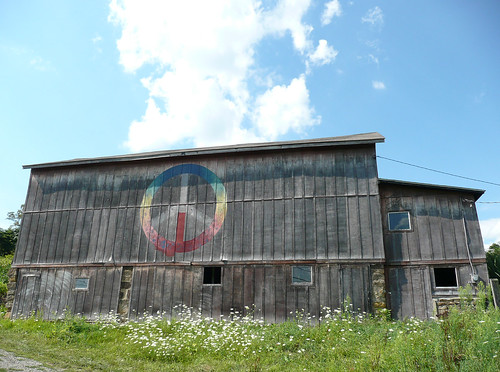
Here we have apparent peace, love and understanding on a farm in Center Township, Beaver County, Pa.

Wednesday, August 20, 2008

Tuesday, August 19, 2008
Nightmare on North Central

Vandals have caused rather severe damage to this old house that is the only still-standing relic of the oldest college in the United States west of the Alleghenies. It's a larger tragedy that this house was allowed to fall to this state of disrepair in the first place.
Here is a story about the vandalism that appeared today in the Observer-Reporter:
CANONSBURG, Pa. – The vandalism to the last surviving Jefferson College building couldn’t have been found at a worst time.
Extensive damages were found Friday inside the historic Roberts House in Canonsburg, Pa., on the same day a nonprofit obtained its federal tax-exempt status to raise money for its restoration.
“It just makes you sick to the stomach,” said Canonsburg Mayor Anthony Colaizzo, who also is a board member of the group that wants to turn the house into an arts center.
The log, stone and brick house, with portions dating to the 1790s, was used for decades as a home for presidents, vice presidents and the faculty at the college before it merged to become Washington & Jefferson College. Founded in 1787, Jefferson College was the first school for higher learning west of the Allegheny Mountains. John Roberts then operated a post office and general store in the house, beginning in 1808.
To the dismay of the Washington County Cultural Trust, vandals reduced a priceless cherry bentwood stair railing to pieces. An antique mirror was shattered, too, as were many windowpanes.
“It was a senseless act of vandalism,” Colaizzo said. “You’d have to be sick to do it. I am just lost for words.”
This isn’t the first time vandals have struck Canonsburg in recent months. In mid-June, someone scrawled the word “nemesis” in black spray paint on houses and vehicles in the East End of the borough – about 30 tags in all.
Canonsburg police continue to investigate the incidents, which detectives said caused between $15,000 to $20,000 in damages.
Police and firefighters also were called Saturday to St. Patrick Church on Pike Street after a recycling bin was set on fire.
The trust had reached an agreement for the house to be purchased by Pittsburgh History and Landmarks Foundation for a year. The foundation is expected to sell the house with a sagging roof at 225 N. Central Ave. back to the trust.
The Landmarks Foundation dispatched a crew to the house to resecure it Monday.
For information, call 724-514-6106. Donations for the restoration project can be mailed to the trust at P.O. Box 45, Canonsburg, PA 15317.
Sunday, August 17, 2008
Mon "Calendar Girls" in the news

WQED Multimedia's short documentary featuring the older Monongahela women who posed semi-nude for a 2008 calendar is up for an Emmy Award.
The show on OnQ, "Calendar Girls," is nominated in the entertainment program feature or segment category. It's among 23 nominations the public television station picked up in the awards that will be announced Sept. 13.
David Solomon is the supervising producer of the segment on the women who raised more than $10,000 for the Monongahela Area Historical Society. He's the same guy who produced that station's great documentary, "Stone Soldiers," about decaying Civil War monuments in Gettysburg.
Here's wishing that WQED breaks a leg, and that more good fortune comes to the Vixens of the Valley, who also helped to put this blog on the map.
(Caption: Dot Krol, a fitness technician, left, and Peggy Savadeck, a Senior Olympics gold medalist, greet their fans in 2007 at a firemen parade in Monongahela)
Donora "Man of Steel" grave was a hoax

DONORA, Pa. – It seems that nearly everyone in this town bought a story about the burial of a “man of steel” who died tragically in a crucible of molten metal.
Until their deaths, even Andrew Posey’s 10 siblings held tight to their belief that U.S. Steel created a special grave in Donora, Pa., beside the open hearth for the steel that instantly devoured him in the 1920 accident.
“I think there was a lot of pressure from the family put on the mill,” said James McKenzie, a retired North Dakota University English professor who grew up in Donora, and, for a time, believed the tale.
But evidence surfaced this week that suggests the burial was nothing more than a hoax at a time when the life of a steelworker meant little to America’s steel barons.
The Mon Valley Progress Council Inc. released a report to the Observer-Reporter on an excavation it conducted in 1995 at the site that revealed nothing more than undisturbed earth in a section 8 feet deep around Posey’s tombstone.
“This completes all work toward (the) memorial site investigation and we conclude that this site is a memorial only and no slab or ingot of steel is located within the area of our investigation,” the engineer, Samuel M. Bitonti, noted in his report.
“We were very interested in finding it,” said Joe Kirk, the council’s executive director, who went in search of the steel while trying to sell the site to a new manufacturer.
“I wonder if it was all graveyard PR theater to make the family feel better,” said McKenzie, who wrote an essay about Posey that was published in Notre Dame Magazine’s winter 2006-07 edition.
Posey, who was born July 4, 1898, had just returned from service in World War I when he was hired as a ladle stopper checker in the open hearth. His job required him to climb down into the 100-ton ladle on Jan. 8, 1920, when an explosion in the back of the furnace covered him with 3,000-degree steel, McKenzie, of St. Paul, Minn., wrote in his essay.
 Posey’s brother, Joe, built a low, yellow firebrick wall 20 feet wide and 15 feet long around the “grave” after the family was told the entire fatal 65-ton ingot was buried at the site, McKenzie added. A small concrete cross holding a bronze plate containing the steelworker’s name in raised letters rests on the ground.
Each year, war veterans place an American flag on a medallion beside the cross. Others have been known to decorate the stone with artificial floral arrangements.
The local newspaper, The Valley Independent, had earlier repeated the myth, unquestioned, in a 1968 article that pondered the fate of the memorial after the mill closed.
“After the accident, the entire heat of steel containing the remains of Posey was placed into a grave on a plot of ground on the steel firm’s property,” the article states.
And the Pennsylvania Historical and Museum Commission even honored the “grave” as eligible for protection under the National Register of Historic Places in 1992. It went as far as to send a researcher to Donora to interview former mill boss Glen Howis, who repeated the burial story as truth.
“The young man’s remains sealed within the steel were loaded from the open hearth area onto a rail car and carried via a rail spur to the vacant area … where the mass was buried,” the narrative of the PHMC research states.
Now, in light of the Progress Council report, the agency is unsure whether the Posey site can survive the National Register, said April Frantz, a commission survey coordinator.
“I don’t know … just because a whole hoax was perpetuated and the story was that good,” Frantz said.
She said it could survive the distinction because it sheds light on the way “the company operated and how it treated its workers.”
When he revisited the site Tuesday, McKenzie, 67, said a bigger mystery exists as to why Posey was afforded any special attention by the company in an era when as many as 900 steelworkers died on the job a year in the Pittsburgh region.
The company could have been attempting to keep peace with workers who had just returned to their jobs from the bitter first labor strike against U.S. Steel in 1919. During the walkout, a band of Donora steelworkers set off dynamite at the homes of two of their coworkers who crossed their picket lines. Another angry mob of striking workers, their wives at their sides, assaulted and disarmed the police chief when he escorted mill bosses through the gate to the Donora zinc works.
The labor dispute was marked by other riots, one of which involved 50 men who threw bricks at black scab laborers, according to headlines pulled from The Donora American.
“This is the only 'grave' of its kind in America,” McKenzie said.
“I wonder if there was any ceremony at that site at all? Did they move in a rail car for theatrical purposes? Blade up the surface a little to fool the grieving rubes? We’ll probably never know.”
Regardless, Jeff Huff, who manages a nearby warehouse for Elizabeth Milling Co., regularly mows the grass around the Posey plot out of respect for any relatives who still may live in the area.
“There was a time family members would come to visit,” said Dave Felgar, manager of Elizabeth Milling, which doesn’t own the Posey land. “Less and less, they’ve been coming.”
(Caption: Former Donora residents James McKenzie of St. Paul, Minn,, right, and his friend, Paul Rank of Rock Cave, W.Va., visit the so-called Andrew Posey grave in their hometown.)
First published in the Observer-Reporter
Friday, August 15, 2008
Buffalo wings really were born in Buffalo, NY
Stay tuned for a restaurant review from "Travel with a Beveridge"
Thursday, August 14, 2008
A tearful goodbye to a fireman

STOCKDALE – Watching Linda Whiten follow her husband’s casket away from his funeral today made everyone who was there cry with her.
She carried a folded flag while clutching the arm of her son Sean, who shares his father’s first name and love of fire departments.
Even newspaper photographers who didn't know Roscoe Fire Capt. Sean T. Whiten, 47, wept with the nearly 1,000 mourners who came to the funeral in Stockdale Volunteer Fire Department along the Monongahela River in southwestern Pennsylvania.
I hardly knew Whiten, having just talked with him on the telephone a few times about his fire calls in the years before he died of a heart attack Saturday. He collapsed while teaching fire school for Westmoreland County Community College near Smithton.
But surely he was a helluva nice guy like his brother, Bob, who has been fire chief for many years in nearby Charleroi. Bob serves his community well and always presents himself in public as a gentleman in times of stress.
The Whitens are the type of community minded people who can make hundreds of brave men sob in their footsteps.
Subscribe to:
Posts (Atom)