a newspaper man adjusts his pen

Monday, December 3, 2007

This castle is dark and dreary


BROWNSVILLE, Pa. – Nemacolin Castle is a spooky old mansion in southwestern Pennsylvania where upwards of 10 ghosts supposedly roam its halls. It’s no wonder. The 22-room house, most of which dates to the 1850s, has creaky floors, cold drafts and dark furniture befitting of the eccentric Bowman family that lived there for three generations.

While most house museums have to purchase period furnishings unrelated to their occupants, Nemacolin is filled with artifacts that belonged to the Bowmans as far back as 1787 when Jacob Bowman built a trading post on the hill overlooking the Monongahela River in Brownsville.

The rustic trading post still exists, nestled deep among the rest of the rambling house built in the Colonial and Victorian styles of architecture. Tour guides will demonstrate an old iron contraption that puts ruffles into suit collars and a hand cranked vacuum cleaner that touched the hands of the Bowmans or their servants.

When the lights are turned on, you can actually see your aura in a giant diamond backed mirror above a mantle. In a bedroom, the image of the devil appears in the woodgrain on a headboard.

Docents tell ghost stories each Halloween as they lead visitors through the house that is surrounded by a thick stone wall with glass shards embedded the top to ward off visitors. Many children supposedly went home with brush burns and cuts after they ventured over the wall to peek inside the many windows that adorn the brick structure.

Fayette County bought the estate at the west end of Front Street in 1965 after the deaths of the last occupants, Charles and Lelia Bowman, and turned it over the Brownsville Historical Society.

Society members also offer candlelight Christmas tours each December. But, with the lights dimmed low at those times, it’s nearly impossible to appreciate the place and all of its splendor.

Before the sun sets, you can see a lot of chipping paint around the windows and shutters that suggests the historical society needs money for restorations. In some ways though, the neglect makes the place seem all that more spooky and weird.

Click here for more information about tours and events.

Friday, November 30, 2007

The original embedded photographer


Mathew Brady became the father of photojournalism in the United States for the large collection of horrific battlefield images that he amassed during the Civil War.

Among the most gruesome were those that were captured by two of his photographers who were dispatched to the Battle of Antietam, following the Sept. 17, 1862, fighting that became known as the bloodiest single day of the war.

The photos were later displayed at Brady’s New York studio. A line of people stretched around the block to see the them, and many walked away shocked and dismayed by their first view of dead bodies scattered about a battlefield. The nation had been used to just seeing glorious woodcuts of battle scenes that tended to romanticize the war. For the first time, Americans began to look at photography as something other than staged portraits. It was almost as if Brady had dropped off the corpses at the front door of American houses, The New York Times reported. While Brady didn't shoot most of the shots, he "brought home to us the terrible reality and earnestness of war," the newspaper suggested.


Brady, who also photographed President Abraham Lincoln, thought there was money to be made in the project that cost him nearly $100,000 but left him penniless. The photos were just too hard to digest at the time. But Brady didn't regret his decision to document the war.

“I had to go. A spirit in my feet said ‘Go,’ and I went,” Brady has been quoted as saying.

Eventually, the Brady collection was purchased for $25,000 by the U.S. government. It is now considered to be a priceless account of the war.

This story is among many included in an audio tour of Antietam Battlefield, a beautifully manicured National Park just outside of Sharpsburg. For $20, you can purchase a self-guided tour at the gift shop, pop a CD into your car’s CD player and drive around park at your leisure. The Travel Brains tour comes with a hand-held field guide and sound affects like canon fire and actors with different accents to add to the drama. While I prefer to interact with real-time tour guides, this is a great alternative, especially if you want to duck out early and listen to the story on the way home. Besides, a personal tour of the battlefield comes at a price of $50 at the gift shop.

The park, unlike Gettysburg in Pennsylvania, hasn’t changed much since the battle waged by 40,000 Southern troops and 87,000 federal soldiers that killed 23,110 men. Unlike Gettysburg, there are no McDonald’s arches on the horizon. With the Brady photos in hand, it’s not hard to imagine the fighting, especially along the hotly contested Sunken Road where nearly 5,000 soldiers met their deaths during four hours of fighting.


The north was victorious in what was the first of two efforts by Confederate Gen. Robert E. Lee to fight the war on northern soil. Before the photographers went to work at Antietam, one general who was there took the time to pen the following observations:

“In the time that I am writing every stalk of corn in the northern and greater part of the field was cut as closely as could have been done with a knife, and the slain lay in rows precisely as they had stood in their ranks a few moments before,” Major Gen. Joseph Hooker of the Union Army of the Potomac noted in his journal. “It was never my fortune to witness a more bloody, dismal battlefield.”

(Captions: Mathew Brady, top, and one of his battle scenes from Antietam, photos that are in the public domain. The Sunken Road as it appears today in a photo by Scott Beveridge)

Monday, November 26, 2007

Those funny balloons


The creative staff at The Warhol in Pittsburgh has been doing some redecorating.

The small gallery on the first floor now has a cool timeline that walks visitors through the interesting life of Andy Warhol, from his 1928 birth into a working-class Rusyn immigrant family to his untimely death from heart failure in 1987.

The condensed biography running the length and height of four walls, however, leaves out the motive for a shooting that nearly left Warhol for dead in his studio. For those with inquiring minds, Valerie Solanas, a founder of the Society for Cutting up Men (SCUM) who also acted in a Warhol film, shot him in 1968 after she was turned away from the his studio, The Factory. (I'd have slammed my door in her face, too, for coming up with such a group)

The artwork that used to hang there can be found scattered among The Warhol’s vast collection that consumes seven floors of an old building at 117 Sandusky St., the largest museum in the world for a single artist.

Thankfully, they didn’t mess with the Silver Clouds Installation, a replica of a 1966 exhibit of helium filled balloons that dance with the wind from forced air. Warhol, it seemed, was put off by stuffy museums where visitors were not allowed to touch the art. Today, people can’t help themselves from smiling or letting loose and acting like a kid inside the room.

Through the end of the year, a collection of minimalist paintings by Georgia O'Keeffe is on display. The seven watercolors were completed in the 1970s when the artist was going blind in her 80s.

Click here for a related story...
(FYI - that's my incredibly talented niece Casey Beveridge in the photograph)

Saturday, November 24, 2007

Christmas@pitt.edu


The Romanian Room in the Cathedral of Learning at the University of Pittsburgh is among many ornate ethnic classrooms that can be found on the first two floors of the landmark. The rooms are especially interesting to see during the holidays when volunteers dress them according to holiday traditions that are celebrated in the countries that funded their construction. Here is a story pulled from the archives of the Observer-Reporter newspaper in Washington, Pa.:

OAKLAND, Pa. – The knoll was little more than a scrappy plot of land where circuses set up camp during the summer when it caught the attention of a former University of Pittsburgh chancellor.

As the school’s 10th leader in 1921, John Gabbert Bowman envisioned a building so grand on the hill that it would inspire young men to remove their hats upon entering its doors. He then went looking for wealthy benefactors to underwrite his plan, many of whom thought he was out of his mind.

“The Mellons said: ‘We’ll buy the plot, but don’t ever mention the tower,” said E. Maxine Bruhns, director of the Nationality Rooms at what became a monumental Gothic building named the Cathedral of Learning.
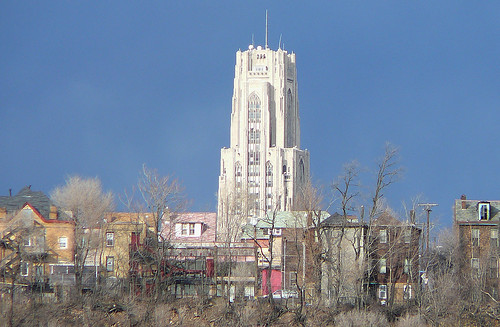
Storm over Pitt
The high-style rooms, which have been decorated each December according to the appropriate Christmas, New Year’s or Jewish holiday traditions since they opened, have helped to make the university famous around the globe, Bruhns said. But to build the cathedral, Bowman was forced to turn to working families for the money. He realized that the sweat of immigrant workers had built Pittsburgh into an industrial giant of his era.

“Once they have a room here, they will stay and go to school here,” Bruhns said, quoting the chancellor.

The different ethnic communities responded with remarkable determination to find the money to afford only the best adornments to show off their heritage. The host of the Sunday afternoon Ukrainian radio program on WPIT put out a call for listeners to send money to honor their ancestors when the Ukraine room was being designed in the 1980s. Nearly $15,000 in donations poured in the first day, with many from women wearing babushkas, or kerchiefs, on their heads, Bruhns said.

“These mothers would cry in their kitchens with their Ukrainian music on the radios,” she said.

An artist was sent to Ukraine for a month to study how ceramic tiles were crafted to cover the stove and chimney of a nobleman’s reception room. Re-created on the third floor of the 42-story cathedral, the richly paneled Ukraine room boasts sculpted copper panels that tell the story of how the country’s culture was developed.

Eventually there would be 26 Nationality Rooms in the 535-foot tower, which took a decade to build with money coming from 17,000 adults and 97,000 schoolchildren who gave the university as little as a dime. Local industries provided the steel, heating and plumbing, concrete, glass and elevators for the steel building covered in Indiana limestone that turns 80 next year.

The rooms continue to serve as working classrooms, where visitors might encounter a cranky professor if they knock on a door and interrupt a lecture.

Typically, it takes a decade to plan and complete one room at a cost, today, of nearly $500,000. While the rooms are ornate, the holiday decorations in them are kept to a minimum and must represent traditions true to the culture.

And, while the Greeks do not mark Christmas, they honor St. Nicholas, and housewives typically bake bread at this time of year and cover it with frosted decorations that represent the family’s occupation. In the marble Greek room, a loaf of bread decorated with seashells sits on a table beside the celebrated patron saint of seaman.

Ukrainian families put candles in the loaves of bread and set them by windows as a sign that wayfaring strangers – like Joseph and Mary – are welcome in their homes.
While nearly 40,000 people tour the rooms a year, tourism promoters have called the building one of Pittsburgh’s best-kept secrets.

“We’re known abroad more than we’re known here,” Bruhns said. “People in Paris don’t go to the Eiffel Tower.”

She said new visitors with strong ethnic ties are grateful that there is someplace in the world that “perpetuates, authentically” their culture.

“It’s important to the people who grew up with the traditions,” she said.

Following is a sampling of the traditions across the globe that are celebrated in the Nationality Rooms at Pitt:

In Japan, it’s customary to place evergreen sprigs and bamboo, or kadomatsu, at the gates to homes at New Year’s. The arrangements were believed to serve as temporary shelters for the deity Kami who delivers longevity and wealth at the start of each year.

Germany claims to have started the tradition of celebrating the holidays around a Christmas tree. It began in the 720s after St. Boniface decided to take on pagan rituals by chopping down a large oak tree where people worshipped Thor, the god of thunder. It was Christmas Eve and the eldest son of a chieftain was to be sacrificed. The saint invoked a miracle by causing the oak to fall with one stroke of an ax. He pointed to a nearby evergreen and bid the hostile tribesmen to take one home as a symbol to the Christ child. He claimed the branches represented endless life.

In Scotland, it’s considered back luck to fall asleep before midnight on Christmas Eve. According to legend, people also are warned to keep a fire alive all night to keep elves from sweeping down the chimney and dancing in the ashes. To this day, most churches perpetuate the tradition by holding watch-night services on Christmas Eve.

In Ukraine, people decorate their windows with homemade spider webs. The tradition stems, in part, from the belief that the first thing the Christ child saw when he woke up in the manger were bits of dew collected on spider webs. It was his welcome to the world, according to the myth. They also decorate with didukh, or a sheaves of oats or wheat shaped with four legs to symbolize prosperity for the new year.

After Christmas Eve dinner in Sweden, the Tomte, or Christmas gnome, appears dressed like Santa Clause. The Tomte supposedly lives under the floorboards and rides a straw goat named Julbok. He passes out gifts to the well-behaved children while the goat bumps the bad kids.

In Lithuania on Christmas Eve, the house must be painstakingly cleaned before the evening meal. Fine hay is spread across the table as a reminder of the manger and it is covered with a fine white tablecloth. After dinner, the children take turns pulling out a strand of the hay. The child with the shortest straw will be the first to marry, while the sibling with the longest will enjoy a long life. The Christmas tree also is decorated with simple ornaments woven with straw.

In ancient Ireland, a winter wren was driven from a bush, killed and its body hung on a holly bush over beliefs its song betrayed a Christian hiding from his persecutors. Today, boys dance to homes carrying a stuffed wren and sing for Christmas treats.

(The German Room)

Friday, November 16, 2007

D.C. from behind bars


There is a way to an awesome birds-eye view of the nation’s capitol without having to wait in long lines at the beloved Washington Monument.

First, duck into the basement of the Old Post Office Pavilion, where a glass elevator departs every five minutes for free tours of a giant tower, which makes the building the third largest in the city.

“It’s kind of like a hidden gem with a great view of D.C.,” National Park Service ranger George McHugh said on a chilly Dec. 12 afternoon when there were just three people on the top deck of the 315 stone tower.

The massive building stands on Pennsylvania Avenue about halfway between the U.S. Capitol and White House. It was constructed between 1892 and 1899 in the Richardsonian Romanesque style of architecture, which was popular at the time in American cities. But 15 years later, the post office with a massive glass-covered central courtyard had become obsolete because the volume of mail in the United States had increased at a rapid rate.
The last postal workers were relocated from the building in 1934 and it was quickly abandoned prior to its pending demolition, a plan that was stalled as the government fell short of money heading into the Great Depression.

For decades, the landmark fell into disrepair while preservationists debated the building’s fate with those who considered it an eyesore and wanted it erased from the landscape.

Lawmakers eventually earmarked money for demolition in the 1970s but their plan drew protest marchers to the sidewalks in a movement to save it from the wrecking ball. The publicity helped to spur restorations on what is now considered a classic downtown monument worthy of exploration.

The elevator, which offers a dizzying view of the offices and street-level mall, lets off passengers on the ninth floor.


Signs guide them around a tiny museum and a room where volunteers periodically ring the The Congress Bells, which were a bicentennial gift from Britian. They ring out a pitch and tone similar to bells in Westminster Abbey in London.

A second elevator whisks visitors to the observation deck on the 12th floor that overlooks office buildings with lush rooftop patio gardens, the Washington Monument and the city’s sprawling blocks of buildings, none of which are taller than 120 feet. City official in 1910 limited the height of buildings because the fire department’s ladders were no taller than 120 feet.

The 555-foot Washington Monument is the tallest structure in D.C. The Basilica of the National Shrine of the Immaculate Conception is just 16 feet taller than the old post office.

The pavilion tower, meanwhile, is enclosed in bars of thin cables and plexiglass to keep the pigeons out and “the people in,” McHugh said, while thanking the visitors for stopping buy.

Nancy Hawks, the woman who led the 1970s protest to save the old post office, said it best, “Old buildings are like old friends … They encourage people to dream about their cities, to think before they build, to consider alternatives before they tear down.”