a newspaper man adjusts his pen

Saturday, March 31, 2007

Thai cuisine brewed right

PITTSBURGH, Pa. – The delicate blend of flavors that gives Thai food its appeal can be found in the country’s most-popular brand of beer.
Singha
is a barley malt that has the right amount of cinnamon, flower and lemon additives that have helped to crown it the No. 1 beer of Thailand. It’s a product of Boon Rawd Brewery of Bangkok and brought to the United States by the Paleewong Trading Co. It’s a great compliment to Thai cuisine wherever it is served, especially in Pittsburgh, which seems to have more Asian restaurants per capita than any other city in the United States.

Tapas, or small plates of food, continue to draw me to the Silk Elephant in Pittsburgh’s Squirrel Hill district. On my last stop there, I had Tom Kah, a delicious coconut broth with shrimp, mushrooms and peppers, and roasted leg of lamb swimming in green curry sauce with steamed vegetables.


Thai food has a perfect balance of aromatic ingredients that are spicy, sweet, salty, bitter and sour, my server said while offering her reasons for loving the food.
“You taste it and think, ‘Oh. What is that?’” she said. Often it’s the fresh, rather than dried, basil and lime leaf that give the food its distinctive character, she added.
The Silk Elephant is casual and intimate yet classy with its high-back, upholstered chairs and silk draperies. The servers are young and hip. The soup, which came with three large shrimp, cost $4.65, while the lamb had a price of $7.95. The bottle of Singha was well worth $5.50.

The restaurant is located at 1712 Murray Ave. For information call 412-421-8801.

Thursday, March 29, 2007

Pool of memories


The infamous Donora zinc works, shown above in a photograph taken circa 1945 in Webster.

By Scott Beveridge

DONORA, Pa. – By some accounts, residents of Donora had begun to complain about a foul odor shortly after U.S. Steel Corp. opened a zinc mill in their neighborhood a century ago.
The mill superintendent, however, insisted that the air was safe to breathe, so the story goes. To prove his point, he moved his family, including an aging relative, into a mansion he had built on a hillside directly above the row of smokestacks.
Those living arrangements in 1916 didn’t last long. That same year, the company began construction of a plan of airtight, Prairie School blockhouses for its bosses on a hillside at the edge of town as far away from the mill as possible.
The plan of houses, where flowers bloomed and trees grew tall, became known as Cement City. There wasn’t a blade of grass, however, on the ground in the immediate vicinity of the mill. The hills were barren of trees, too, downwind and across the Monongahela River in the scrappy village of Webster. The vegetation was sacrificed for a top secret operation that forged metal plating with the strength to bulletproof U.S. military tanks.
The boss' stately, three-story brick mansion would be donated to Donora’s Spanish immigrant community, whose strong, young men had the right genetics to withstand the torturous heat while working beside the zinc smelters.
Donora would become infamous for a killer smog that was the impetus for the nation’s first clean air legislation in 1963. Stagnant air had trapped the mill's pollution in the deep valley town for three days in late October 1948. Twenty people died gasping for air and hundreds were sickened by the fumes, before rain moved in and allowed the pollution to dissipate. The event prompted physicians to publicly link air pollution to poor health for the first time.
Also in the 1960s, the Donora Spanish Club was home to the town’s only outdoor, exclusive swimming pool. My family, and our white Anglo-Saxon Protestant relatives, were proud to wear Spanish Club patches on our bathing suits. While I don’t remember anyone saying it out loud, the club had an unwritten rule then that blacks were not allowed in the pool.


Racism had nothing to do with keeping the water clean. I suffered many reoccurring inner-ear infections from spending too much time scavenger hunting on the bottom of the deep end of the pool.
Still, it was a safer alternative to swimming in the filthy, dead Monongahela. And the club’s bartender provided my father with beer on Sundays at a time when state law prohibited public bars from opening on the Sabbath.


Today, four decades after the mill shut down for good, there is a lush jungle on the Webster hillside. The river runs much cleaner now that the company, and many others like it that once dotted the region’s landscape, no longer dump acid byproducts directly into its water.
Somehow, the Spanish Club manages to stay open in harsh economic times in Donora. Although the big house on the hill looks badly in need of attention, the swimming pool should be open this summer. Last year, it was refreshing to see a few black children running around its lawn.

Wednesday, March 28, 2007

She has the right moves


Several years ago, Violet walked, like, 10 miles to say hello to baseball legend Stan Musial, when he came home to Donora, Pa., to sign autographs. I'm glad to still see her smiling and wearing her "happening" boots on the sidewalk.

Coast is clear


By Scott Beveridge

EASTVILLE, Va. – At the height of summer travel season, the most that can be found on a bay-side beach at the Eastern Shore in Virginia are a few empty folding chairs.
There might be a lonely boat, too, anchored between blue crab traps in the water, as this Chesapeake Bay shoreline has miraculously escaped over development common to vacation spots like Ocean City, Md.
“Our tiny peninsula is the last pristine stretch on the East Coast,” boasts the Eastern Shore of Virginia’s Web site. “Where the bay meets the sea, watermen till the tides and family farms stretch lush and green. Our small towns are as Southern as sweet potato pie.”

The Jamestown government, led by Capt. John Smith, staked claim to the 20-mile-wide strip of land in 1620. Some of the same old family names hold title to its sprawling working farms to this day.
The tiny colonial town of Eastville can be found 48 miles north of Norfolk and across the Chesapeake Bay Bridge/Tunnel, whose high tolls help to keep visitors away from the peninsula.
With its 42 families and 203 residents, Eastville is the county seat of Northampton County. It’s courthouse holds the oldest continuous court records in the United States.

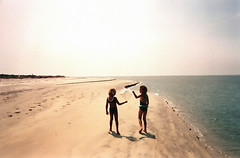
Off the Atlantic shore to the east sits an abandoned U.S. Coast Guard hurricane station, the remains of which are shown below:

Atlantic island

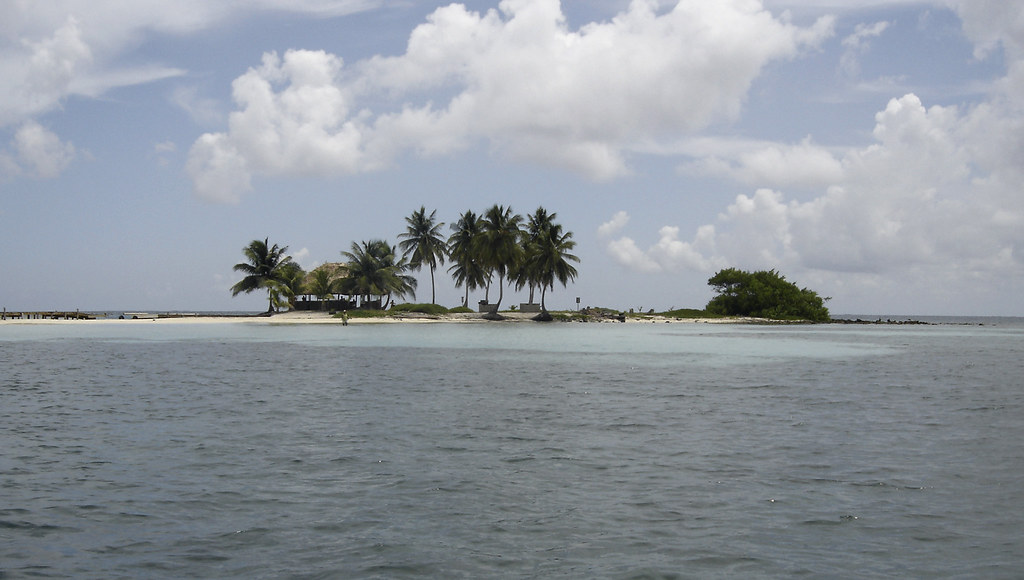
A row of aging private beach cottages can be found a few miles west along the dead-end Smith Beach Road. Some are available as short-term rentals, if a traveler is lucky enough to know the right local residents who can put them in touch with a property owner. People here don’t tend to answer their telephones. If you ask around, however, you can find a guide and a boat to one of the deserted islands in the Atlantic Ocean.

Atlantic island

At the same time, it might be difficult to pull away from a beach chair. The Smith Beach cottages, and their bare-bones accommodations, provide views of spectacular sunsets and the perfect oasis to plant yourself with a good book.

Monday, March 26, 2007

At ease in Belize


By Heidi Price

AMERGRIS CAYE, Belize – I have three sisters who work as flight attendants, all veteran travelers, all with differing views on what constitutes a getaway.

The eldest and most traveled among us is clear – she wants luxury, time away from the everyday intrusions of reality. The youngest enjoys lying on a beach, going out at night and shopping in all its forms.

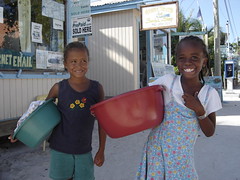
So I invited, Julie, older than me by two years and a wanderlust at heart, to join me on a trip to Ambergris Caye, an eco-touristy island off the coast of Belize that offers spectacular diving and snorkeling, but little in the way of shopping – except young children who roam the streets, barefoot, selling cinnamon rolls their mothers baked for 50 cents, who are shown below:

DSC00114

We set our departure date for early September 2004. Several travel Web sites and books warned that this was the high noon of hurricane season and going anywhere near the Caribbean was a mistake. But I was looking forward to exploring Belize's barrier reef – 185 miles of coral caverns and colorful fish, second only in size to Australia's Great Barrier Reef.

Armed with my Lonely Planet Guide Book – in my opinion the most comprehensive among travel guides – I began perusing hotel Web sites. After several hours, I found my best deal, Mata Rocks, which offered five nights for $230 per person. The price included a continental breakfast each morning, bicycle rentals and one diving and/or snorkeling trip.

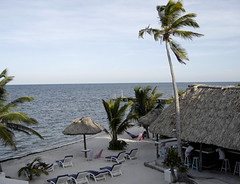
Belize ocean view

Touching down

On Sept. 6, our plane touched down in Belize City. Two air taxis also offer connecting flights from Philip Goldson International Airport, but my sister suggested we take the water taxi, which leaves hourly from the Belize Marine Terminal in the center of Belize City. We purchased two round-trip tickets for $55, and soon we were gliding over crystalline blue waters. More than an hour later, we approached a small dock in San Pedro, a small town on Ambergris Caye and the inspiration for Madonna's song "La Isla Bonita."

I was surprised. With Hurricane Frances winding down and Ivan rumbling toward the Caribbean, I thought the streets would be empty. Instead, they were crowded with honeymooners, divers and residents, all traversing the dusty streets in golf carts, bicycles or on foot. The only vehicles I saw during my stay were taxi cabs and the occasional delivery truck.

Beyond its reef, Belize is an unsophisticated, unspoiled home to manatees, marine reserves, caverns and, farther inland, near the Guatemalan border, ancient ruins. As the country, formerly British Honduras, celebrates its 23rd year of independence, it faces an identity crisis: maintain its unspoiled beauty while playing host to its No. 1 industry – tourism.

One brochure noted that 40 percent of Belize is now protected by reserves. Two such protected areas are just a half mile off the coast of Ambergris Caye: Shark Ray Alley, where you can swim with nurse sharks and Southern Sting Rays in shallow waters, and Hol Chan Marine Reserve, where snorkelers and divers can explore marine life through a cut in the reef more than 30 feet deep.

Underwater travel

Manual, our guide our second day out, spent nearly two hours exploring Hol Chan with us. He swam with us the entire time, teaching us how to find sea pearls, identify tropical fish and clean our masks with sea grass so they wouldn't fog up. Manuel, who is of Mayan descent, knew his marine biology, not leaving until he had shown us every fish on the reef including a Yellowtail Damsel fish, my new favorite.

On the way to explore another site, Manuel stopped his boat to show us a "Laggerhead" snapping turtle, which he estimated was 80 years old and I estimated to be about the size of a Mini Cooper.

Several of our day trips included stops in Caye Caulker, a neighboring island brimming with twentysomethings and $5-a-night room rates. Most tourists on the island converge at the Lazy Lizard, a watering hole on "The Split," a gash where Hurricane Hattie split the island in two in 1961.

One afternoon, while exploring Front Street, my sister tried to knock a coconut out of a tree. A man watching from his front porch held up a finger signaling us to wait, and five minutes later we were drinking fresh coconut milk out of two coconuts in which he had drilled holes.

I found that type of warmth and response from everyone we met during our weeklong trip with one exception: a diving instructor, the only one we didn't book through our hotel, who stole my sister's camcorder. We thought it was lost, but I was amazed to receive an e-mail from our hotel a few weeks after our return stating that a security guard who we befriended at the neighboring hotel had "recovered" the camcorder.

I recommend going out with well-established businesses that have long-standing relationships with your hotel.

Daily excursions

One of the best trips, and one arranged through Mata Rocks, was a daylong excursion to see Indian manatees in a protected reserve near Belize City. According to our guide, manatees were once hunted for their ivory, but with a concerted effort, these 1,200-pound creatures are now a protected species and can spend their days eating, resting and, in September, mating.

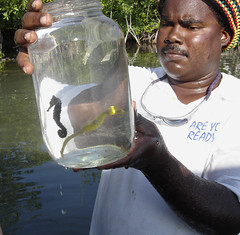
After, we explored the reef around Goff's Caye, our guides grilled on the island and then took us to a popular habitat for sea horses, a few feet off the coast of Caye Caulker.

Belize

We spent another day riding our bikes around the island, visiting the "Living Arts" museum, an outdoor exhibit run by Sean and Jose, who oversee the assemblage of artwork made from abandoned flip flops, driftwood and skiffs found on the island. The museum, a difficult find down an overgrown lane, was free, but Sean bet me $5 that he could wrangle a kiss from Panchito, the museum monkey.

Sean and Jose, like many residents I met on the island, are expatriates. In "Adapter Kit Belize," Lan Sluder wrote that Ambergris Caye is home to the largest concentration of expatriates in Belize.

Most nights we rode our bikes into San Pedro. As the country geared up for its independence day celebration, Sept. 21, children practiced and would happily teach you the Punta, a hip-shaking dance to a rhythmic beat.

Every evening around sunset, tourists gathered at the water plant, about a mile south of San Pedro and not far from our hotel, where a very brave soul would bring out a chicken to feed the crocodile. It always drew a crowd.

"Finding tarantulas and scorpions, that's normal," said Jenna Brandt, 29, a New Jersey native who lives in San Pedro while studying at Medical University of the Americas. "Sometimes, you'll find snakes on the street, pythons."

And while Brandt plans to return to the states after medical school, she's enjoying her life in Belize.

"I love the fact that life is so simple. The locals have such simple lives, their lives are humble," Brandt said.

Thursday, March 22, 2007

Working the Monongahela

As the tugboat, the Arkwright, charts its course along the Monongahela River, inside its tiny kitchen, the cook is the boss.

By Scott Beveridge

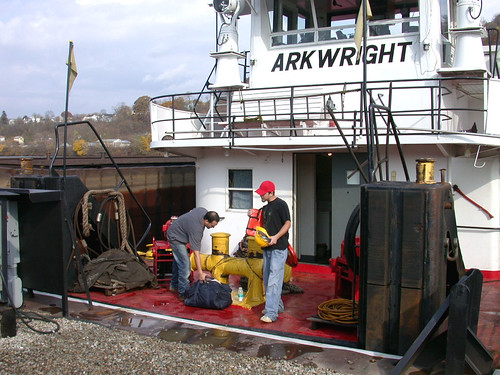
ALONG THE MONONGAHELA RIVER – The Arkwright's engine rumbled, sending short blasts of air to the tugboat's rudders, enough to steer it from shore.

The captain peered from the pilothouse, following orders to hook up with a dozen coal-filled jumbo barges and push them down river to supply a power plant.

While Capt. Don Lowe was at the helm of this 54-year-old tugboat, its seven-man crew was well aware that the women in the galley would call most of the shots while they would be on board for the next week.

"When they say the captain of the boat, they don't look at me," Lowe says earlier, while seated at the dinner table. He rolled his eyes and smiled at cook, Mary Husser, and stepped into the kitchen to follow her standing rule to rinse his dinnerware before retiring it in her stainless-steel sink. "You don't want to piss off the cook," said Lowe, 49, of Pittsburgh's North Side.

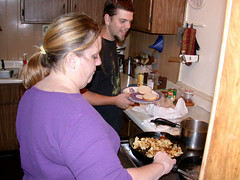
"They get told about washing your hands. Don't go into that refrigerator, into that ice cream without washing your hands," said Husser, 52, one of just 10 remaining female cooks who worked the tugboats that ply the Monongahela River and move tons of coal, gravel, diesel fuel, fly ash and other products to market.
Mary15

Competing towing companies have opted to pay deckhands a few more dollars a day to prepare their meals to cut shipping costs, said Capt. David J. Podurgiel, who coordinates boat traffic for CONSOL Energy, which owns the Arkwright. That setup was bad for morale, Podurgiel said, and could lead to laziness and uncleanliness among boat crews without a woman to mother them.

Husser doesn't tolerate obscene language, cigarette smoke or co-workers who skip too many showers.

"If we're back in the galley, we try to keep our language clean," said Pat Snyder, 22, of South Park, who has yet to log enough hours on the river to master the job of roping and securing rusting steel barges.
Mary1

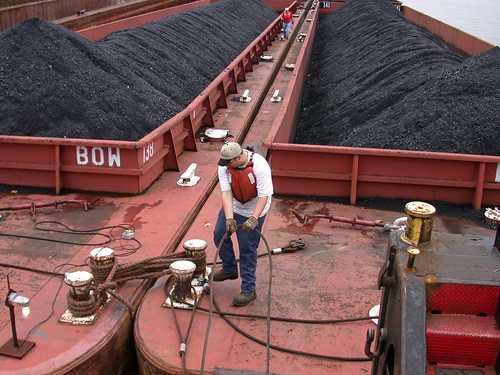
It takes muscle to work these boats - a role that is especially grueling during winter months - when most new guys quit because they can't take the bitter weather, said Russell Wiseman, 49, of nearby Monessen, Pa.,the lead man on the barges who helps the pilot guiding them along the water.

"You make it through the winter, you're good to go," said his deckmate, Kenny McDonald, 23, of Cheat Lake, W.Va. "If it's 20 degrees out there, it's 5 degrees out here. You get the wind blowing off the water..."

"These are a different breed of people out here," added Husser, of Millsboro. "I give them a lot of credit."

Husser was drawn to the Mon 15 years ago, when her two sons were in high school and old enough to fend for themselves while she's away from them, and her husband, Eric, every other week.

"It's hard enough for a guy to do this with little kids, let alone a woman," she said. "Working out here, you miss a lot."
Mary10

"You miss a lot of kids' birthdays, weddings," added Wiseman, after the Arkwright left its moorings in Speers, moving north to Locks and Dam No. in Charleroi at a crawl of 4 mph.

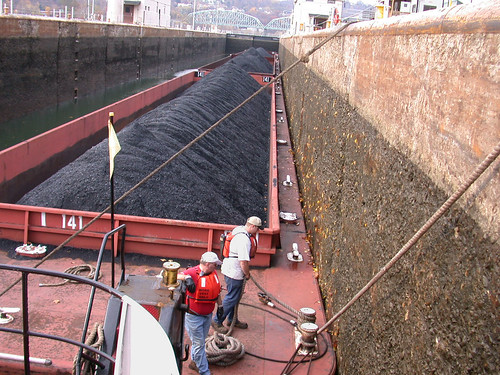
Named after an old deep mine near Morgantown, W.Va., the Arkwright is pushing three barges, each of which is 195 feet long and brimming with 1,500 tons of coal. It will return to Speers to pick up three more loads of coal before embarking for Elizabeth. There are six more barges waiting there for the pass to Pleasants Power Station on the Ohio River in Eureka W.Va., a 406-mile round-trip that will last four days. It would require two, 100-car trains to move this amount coal, at a far greater cost.
Mary14

And, this voyage required a grocery bill of $650 to feed the men who work rotating six-hour shifts between six-hour rests on cots in tiny rooms whose walls vibrate around-the-clock with the steady hum of the engine. They earn between $9 an hour and $12.43 an hour, depending on their seniority, for an 84-hour work week. Their living room is just big enough for a few chairs, a television with a 12-inch screen and built-in videocassette player mounted in one paneled wall.

"It's small," said Husser, whose quarters are just beyond the first door from the stern. "It's the size of a cell, really," she said, unpacking a suitcase carrying her essentials, which include DVDs and paperback books. She has a private bathroom, one smaller than a bedroom closet found in most houses on land.

In the galley, her three refrigerators facing the starboard are freshly stocked with 12 pounds of ground beef, 11 pounds of chicken, six pounds of Delmonico steak, nine heads of lettuce, 15 dozen eggs and three pounds of butter. Forty pounds of potatoes and six pounds of onions are brought on ship, too, for the journey.

"If someone gets up from my table hungry, it's their problem," Husser said. "I make my own bread, buns and cinnamon rolls. I make a to-die-for peanut butter pie," she said, announcing to the crew that this dessert will be on the next day's menu.

"Christmas comes early," said pilot Vince Dentino, 27, of nearby California Borough, reaching for a sample of the first day's menu, which always includes hot dogs, kielbasa and chili prepared by the relief cook.

She's quick to say that this job is no holiday. Once, 18 inches of water rushed into her bedroom in a wake caused by the tugboat, when it suddenly moved faster than its haul, causing it to dip under the barges. "Shoes were floating around," Husser said.

Her worst scare came when her boat "got caught in the rolls," or choppy water below Point Marion Locks and Dam, while the vessel was moving a derrick barge, one designed for crane or drilling work. "The oldest deckhand panicked," she said, before the pilot regained control of the boat.

Other times, Husser finds herself mediating arguments between deckhands whose patience has been tested by spending too much time together in close quarters.

"Donny and I are like the psychotherapists on the boat," she said. "The captain and the cook become the mother and father of the boat. Just think if you are stuck in the house with the family for seven days. It takes some getting use to."

On this day, the cruise downriver is delayed about an hour while mechanics made repairs to the massive, spit-shined engine, which filled the boat's hull. Another half-hour is lost while the Arkwright detours from its route to rescue the stalled Jacob G. and tows that tugboat, owned by Mon River Towing Inc., back to shore in Speers.

Wiseman and McDonald finally secure three coal-filled barges to the bow of the Arkwright before it chugged toward the aging and crumbling Charleroi locks, which have been scheduled for replacement over the next decade by the U.S. Army Corps of Engineers. The barges were lassoed to the lock wall, its front and rear gates swung shut, and gravity lowered the water 16 feet to match the river level in the pool below the dam. The front lock gates opened and a whistle sounded, alerting the pilot that the Arkwright could continue its long journey.

Husser's day would end at 7:30 p.m., after the sun had set and it no longer cast long shadows across the river that rolled with a blanket of new-fallen, yellow leaves. She planned to return the next day to the galley at 4 a.m. to begin breakfast. It's her favorite time of day, she said, when the moon reflected on the near-still current, making it look as if it were a sheet of black glass.

Published with permission of the Observer-Reporter