a newspaper man adjusts his pen
Showing posts with label Civil War. Show all posts

Saturday, April 12, 2014

Mount Zion Church Day 12


The grave of John Keeney, a veteran of the Grand Army of the Republic, is in need of some attention in the cemetery behind Mount Zion Church in Nottingham Township, Pa.

Thursday, August 4, 2011

The Ringgold Cavalry: A Civil War outfit of bushwhackers


Surviving members of the Ringgold Calvalry gathered for this group photograph during a 1903 reunion in Fredericktown, Pa.


By Scott Beveridge

A patriotic fervor swept across Washington and Greene counties in Southwestern Pennsylvania after Confederate troops opened fire on Fort Sumter in Charleston Harbor, S.C., signaling the start of the Civil War 150 years ago.


Local men believed the Union Army would quickly prevail and the war would be over before any of them had a chance to fight, said Mark Tomazin, former president of the Washington County Historical Society.


"Everybody was revved up," Tomazin said.


Few could have predicted then that it would take the North nearly four years to regain Fort Sumter following the April 12, 1861, attack.


In the early months of the war, Capt. John Keys of Beallsville, Pa., petitioned Pennsylvania Gov. A. G.. Curtin to reorganize the Ringgold Cavalry, which formed on July 4, 1847, to enter the Mexican-American War. The fighting horsemen had taken their name from Maj. Samuel Ringgold of Washington County, Md., an 1818 West Point graduate who was killed in that war, and they were eager to serve again.


Keys was "anxious to do what he could (to) save the Union," Sgt. John W. Elwood of Coal Center wrote in his 1914 memoirs, "Elwood's Stories of the Old RinggoldCavalry 1847-1865."


But Curtin turned Keys down because President Abraham Lincoln was interested in recruiting only foot soldiers, Tomazin said. Some of the cavalry members were thought to have been too old for service, added John "Jack" Cattaneo, a retired Ringgold High School history teacher.


"They went over his head to Secretary of War Simon Cameron," Cattaneo said.


Cameron, who had befriended Keys' father while working as a contractor on the National Road, delivered his approval of the cavalry in a letter that arrived in Beallsville June 18,1861.


"It was read and reread until it was almost worn out," Elwood's book states.


By then, the area known today as West Virginia was being brought into the war, and Gen. Thomas Jonathan "Stonewall" Jackson and other Confederate leaders would soon have their sights set on destroying fertile farmland the Monongahela River valley. Those farms stocked the Union Army's food supply. From there Confederates forces planned to march north and attack Pittsburgh, which was a major supplier of soldiers and weapons to the North.


"The Ringgold left with farm horses and ancient weapons. They had to outfit themselves," Cattaneo said.


They had no uniforms or arms other than "flintlock horse pistols" and were required to supply their own ammunition, Elwood wrote.


Of the original cavalry of more than 50 men, fewer than a dozen went to the front lines. The reorganized cavalry left a large crowd of well-wishers in Beallsville only four days after Keys received the Cameron letter with 70 new recruits to serve in Grafton, W.Va., then part of Virginia.


The Ringgold probably never fought in any famous battle, although some of its members fought in the Battle of Gettysburg, Tomazin said.


Among the most famous campaigns the cavalry served in was Jackson's failed Romney Expedition to secure western Virginia. The campaign took place seven months after the cavalry formed, and it became known as Jackson's first major defeat of the war.


Jackson was forced back to Winchester, Va., mostly because of bitter winter weather. His troops were inexperienced. Many soldiers either deserted Jackson or froze to death, Tomazin said.


However, its members marched more than 375 miles in one campaign and traveled at least 800 miles on another, Ralph Haas wrote in his book, "The Ringgold Cavalry, the Rest of the Story."


Haas described the cavalry as an outfit of bushwhackers, or cold-blooded guerilla fighters.


Their mission mostly had them serving as scouts and guards protecting the Baltimore & Ohio Railroad, Tomazin said.


The Ringgold also had numerous skirmishes with the McNeill Rangers, Confederate scouts known for plotting their killings, Haas wrote.


"They served long and hard," Tomazin said.


The two units fought so often that they developed a mutual respect across enemy lines, he said. The onetime enemies even attended each others' reunions after the war ended, according to Haas' book.


The Ringgold would end the war having lost three enlisted men to battle and 19 to disease. Keys, who died in Beallsville Nov. 10, 1863, was among those who succumbed to disease, according to Civil War in the East, an online reference guide to the war.


Four decades ago, Ringgold School District formed and took the name as a tribute to the cavalry.


"To me they were heroes," Tomazin said.


(This story first appeared in the Observer-Reporter)

Thursday, June 9, 2011

The Union giant of the Civil War

A photo of a Civil War veteran known to some as the "Greene County Giant" is on display at Washington County Historical Society's LeMoyne House, a Pennsylvania group that has also claimed him as a local soldier.


By Scott Beveridge

WASHINGTON, Pa. – Civil War veteran William Patrick Bane was a man of great stature, so much so that he has been called the tallest Union soldier to have served in the Civil War.

But just how tall he stood has become a matter of debate, as has his place of residency.

The Washington County Historical Society boasts a photo of Bane with information stating he was 7 feet, 1 inch tall. An online genealogy link listed him as having stood an inch taller.

There also has been a long-standing disagreement as to whether he hailed from Washington County or its southern neighbor of Greene County, sources at the Washington group said.

Many folks over the years have referred to him as the "Greene County Giant." Meanwhile he was photographed, at left, in 1896 outside Sharp Store, a business in Washington, Pa.

Historians have agreed, however, that Bane served in the Ringgold Cavalry, a ragtag Civil War battalion of mostly Washington County farmers, whom kicked ass while protecting the Monongahela River Valley and Pittsburgh from Confederate raids.

Those who have kept the argument going might not have not turned to the pages of the 1914 book, “Elwood’s Stories of the Ringgold Cavalry, 1847-1865,” by Sgt. John W. Elwood of Coal Center, Pa.

The book, one of a few definitive histories of the cavalry, contained the lyrics of a song, “To the Ringgold Cavalry,” penned by May Grant Riggs, a relative of some of the Ringgold boys. It appeared to have solved part of the mystery.

It contained the following passage: “From Greene county then comes tall Pat Bane O’re seven feet and mighty strong.”

Thursday, May 14, 2009

Honoring a Civil War veteran's grave


Kay Stepp of North Bethlehem Township, Pa., stands at the grave of a Civil War veteran that will receive new honors.

SCENERY HILL, Pa. – A small group of Civil War buffs will honor a member of Washington County’s famed Ringgold Cavalry by placing a bronze plaque at his grave.

Members of Camp 120, Sons of the Union Veterans of the Civil War, will place the memorial at 10 a.m. Saturday at the North Bethlehem Township grave of Pvt. James N. Wheeler. He is buried in the Letherman-Tombaugh Cemetery.

The cavalry of 70 men formed July 14, 1847, in Monongahela, Pa., to assist the Pennsylvania Militia in the Mexican War. The soldiers continued to drill after that war, but were initially denied service in the Civil War by the Union Army because they were too old. Members of the company persisted, and eventually went on to great acclaim as some of the toughest fighters in the Civil War.

Wheeler’s small and fading tombstone was located in the aging cemetery on Letherman Bridge Road by his great-grandson, Carl Bowers of Washington, a member of Camp 120.

“The permanent marker, it’s going to last forever,” said Kay Stepp, 73, a club member who visited the grave Thursday. “That one will not last,” he said, pointing to the tiny tombstone that marks Wheeler’s grave.
Camp 120 existed in Washington County in the early 1900s, but went on to disband, Stepp said.

He and a few history descendants of Civil War soldiers reopened the club’s charter a few years ago.

Stepp’s great-great-grandfather, Arthamer Ames, also served alongside Wheeler in the Pennsylvania 22nd Cavalry after the Ringgold was absorbed into that regiment.

“They were the first Pennsylvania cavalry to enter the war,” Stepp said.
Members of his club have adopted the abandoned Salem Methodist Cemetery in West Finley Township, and they meet there regularly to mow the grass.

They also have placed two similar plaques on graves in that cemetery of Civil War veterans. The government-issue markers are provided to them at no charge.

Friday, September 26, 2008

A cemetery befitting of heroes

When the dust settled from the great Battle of Gettysburg, fence posts were uprooted and the bodies of Union and Confederates soldiers were strewn among 5,000 horses that also were killed.

“The only thing you can compare it to is a hurricane,” said National Park Service Ranger Angie Atkinson, while giving a tour in late August through the cemetery where many of the men were buried.

The town of Gettysburg, Pa., home to 2,400 war-weary residents, knew something important had just take place in the Civil War when the U.S. Army took victory over the three-day battle July 3, 1863. No one knew at the time, though, that the battle was turning point in the war for the North, Atkinson said.

Gettysburg quickly set out to honor the 3,500 dead Union soldiers who had been buried in temporary shallow graves with a cemetery befitting of heroes. The remains of another 3,320 Confederate solders killed in the battle would eventually be reburied in Southern cemeteries.

William Saunders, a botanist and native of Scotland who designed the park system in Washington, D.C., was selected to carve from the battlefield the Soldiers’ National Cemetery where President Abraham Lincoln delivered his most famous address.

Saunders spread the graves in a series of arches around an impressive monument, and he wanted the bodies to be buried randomly below flat grave markers. The states were quick to protest that plan so he relented and created sections dedicated to each state that sided with the Union. Separate rows were marked off behind them for the bodies of 979 unknown soldiers who were given knee-high white marble blank tombstones. They all were laid to rest in simple pine coffins, Atkinson said.

American sculptor Randolph Rogers, who designed the Christopher Columbus doors for the U.S. Capitol, was commission to create a national memorial of sorrow to stand in the center of the cemetery. He placed a statue of Liberty atop the marble monument, and she is holding a sword in one hand and a wreath of peace in the other. It was completed in 1869 with four statues seated around the base to represent the chapters of time – history, war, peace and plenty.

This cemetery is a short walk from the new $135 million Museum and Visitor Center of Gettysburg that opened this year. Go there. The place is outstanding.

Monday, September 22, 2008

Walls that can haunt a skeptic


DELAWARE CITY, Del. – Laura M. Lee is a skeptical park ranger, but she admits to having been spooked on more than one occasion while on the job at an old United States military fort off the coast of Delaware.

She once heard a crash shortly after exiting the mess hall at Fort Delaware, a sturdy stone fortress built in 1859 to protect the ports of Philadelphia, Pa., and Wilmington, Del., and later used to hold Confederate prisoners during the Civil War.

She returned to the dining room to find a portrait of Southern Gen. Leon Jastremski that had fallen to the floor, face down. It was the image of a man who had been tricked into believing he was being set free only to be taken to a Confederate camp that fell soon under fire from Union warships.

“It was the anniversary ... of day the ship sailed out of here,” Lee said, following an August tour through the travel destination that consistently wins award for its outstanding programs. "That was weird."

In one corner of this maze of buildings, her co-worker portrays a Civil War blacksmith turning hooks from blazing-hot metal. Nearby, an actor pretending to be a Union soldier hums a mellow tune with a harmonica while standing guard over a “prisoner” chopping wood. Meanwhile, another employee of the Delaware Department of Natural Resources shows a group of children how troops kept guns clean and ready for fire during America’s war between the states.

At the same time, Lee is discussing another ghostly story about the night she slept in one of the bedrooms and was startled awake by a rocking chair in motion when no one else was in the room.

“They tell a lot of ghost stories around here,” she said.

There is good reason to believe tales of horror at this incredibly intact piece of American military history on Pea Patch Island that supposedly formed around the wreckage of a boat carrying a cargo of peas. The land apparently grew around silt that built up when the pea pods sprouted.

Toward the end of the Civil War, the sprawling island became a brutal home to nearly 40,000 captured soldiers and sailor, where 5,200 of them died, mostly from infectious diseases, Lee said.

Jastremski, though, ended up on Morris Island, South Carolina, after he was tricked into trading his watch to a Union soldier to gain freedom. He found himself at a destination so grotesque that he ended up eating rats to survive. Others wearing his coat of arms escaped Pea Patch through outhouses that drained into the bay to certain deaths in swift tides.

Fort Delaware was destined for a much better fate, as it “never was attacked and never fired a shot in anger,” Lee said. It was modernized in 1896 but soon became obsolete after the military tested its defenses by firing a missile from a friendly attack ship.

“They put a big hole in it,” she said.

And the place would become abandoned by World War I because its walls were forever defenseless against airplanes that drop bombs, she said.

As many as 18,000 visitors now take the short ferryboat ride from Delaware City each year to the island to walk around this amazing fort that survives in great shape despite its age.

They cross the heavy bridge over a moat to the puzzling grounds and wonder how and why the rambling buildings took shape and become eager to explore their dark halls.


(Caption: Rob Williams and Sean Carrow portray a Confederate captured at Gettysburg and Union guard, respective, at Fort Delaware)

(Click here to view a slide show of photos from my visit to the fort)

Friday, November 30, 2007

The original embedded photographer


Mathew Brady became the father of photojournalism in the United States for the large collection of horrific battlefield images that he amassed during the Civil War.

Among the most gruesome were those that were captured by two of his photographers who were dispatched to the Battle of Antietam, following the Sept. 17, 1862, fighting that became known as the bloodiest single day of the war.

The photos were later displayed at Brady’s New York studio. A line of people stretched around the block to see the them, and many walked away shocked and dismayed by their first view of dead bodies scattered about a battlefield. The nation had been used to just seeing glorious woodcuts of battle scenes that tended to romanticize the war. For the first time, Americans began to look at photography as something other than staged portraits. It was almost as if Brady had dropped off the corpses at the front door of American houses, The New York Times reported. While Brady didn't shoot most of the shots, he "brought home to us the terrible reality and earnestness of war," the newspaper suggested.


Brady, who also photographed President Abraham Lincoln, thought there was money to be made in the project that cost him nearly $100,000 but left him penniless. The photos were just too hard to digest at the time. But Brady didn't regret his decision to document the war.

“I had to go. A spirit in my feet said ‘Go,’ and I went,” Brady has been quoted as saying.

Eventually, the Brady collection was purchased for $25,000 by the U.S. government. It is now considered to be a priceless account of the war.

This story is among many included in an audio tour of Antietam Battlefield, a beautifully manicured National Park just outside of Sharpsburg. For $20, you can purchase a self-guided tour at the gift shop, pop a CD into your car’s CD player and drive around park at your leisure. The Travel Brains tour comes with a hand-held field guide and sound affects like canon fire and actors with different accents to add to the drama. While I prefer to interact with real-time tour guides, this is a great alternative, especially if you want to duck out early and listen to the story on the way home. Besides, a personal tour of the battlefield comes at a price of $50 at the gift shop.

The park, unlike Gettysburg in Pennsylvania, hasn’t changed much since the battle waged by 40,000 Southern troops and 87,000 federal soldiers that killed 23,110 men. Unlike Gettysburg, there are no McDonald’s arches on the horizon. With the Brady photos in hand, it’s not hard to imagine the fighting, especially along the hotly contested Sunken Road where nearly 5,000 soldiers met their deaths during four hours of fighting.


The north was victorious in what was the first of two efforts by Confederate Gen. Robert E. Lee to fight the war on northern soil. Before the photographers went to work at Antietam, one general who was there took the time to pen the following observations:

“In the time that I am writing every stalk of corn in the northern and greater part of the field was cut as closely as could have been done with a knife, and the slain lay in rows precisely as they had stood in their ranks a few moments before,” Major Gen. Joseph Hooker of the Union Army of the Potomac noted in his journal. “It was never my fortune to witness a more bloody, dismal battlefield.”

(Captions: Mathew Brady, top, and one of his battle scenes from Antietam, photos that are in the public domain. The Sunken Road as it appears today in a photo by Scott Beveridge)

Wednesday, May 2, 2007

The shame of Santa Fe


There isn’t anything more unsightly in perfectly-maintained downtown Santa Fe than the sandstone Civil War monument in its central plaza.
Many people in the oldest capitol in the United States hate it so much that they have called for it to be dismantled and reassembled in a much less visible location.
For historical purposes, though, “it should stay” in the heart of New Mexico’s government seat, Donna Padilla, a local historian, said while leading a group of tourists on a walking tour of the beautiful downtown district.
City officials are rather anal about what can be built in the city settled by Spain in 1598, when New Mexico’s first governor, Juan DeOnate, was sent here with 200 pioneers and 7,000 head of livestock.
New buildings can only be constructed in either the pueblo or territorial styles, no taller than three stories, and painted in any of the 40 approved earth tones. Pueblo buildings are low to the ground and often covered in mud-colored adobe or plaster, and the other approved buildings look similar, but have Greek Revival elements that were favored by U.S. residents who invaded the area in 1848 under President James Polk.

Govenor's palace
(Native Americans sell their wares, above, at the former governor's palace, one of the oldest remaining adobe buildings in downtown Santa Fe)

Judging by the number of misspelled words in the white marble tablets embellishing four sides of the war monument, it’s no wonder it embarrasses some of those who take such great pride in the city’s appearance.
February is spelled wrong in the side that pays tribute to Union soldiers who lost their lives in the 1862 Battle of Valverde, when Confederate troops conquered Santa Fe.
April was originally spelled in Abril – the Spanish word for the month - in another side honoring Union soldiers who were killed a month later when the rebels were forced out of town. The word was carved out, leaving a deeper impression in the marble, allowing the month to be respelled in English.
The first few words in a third tablet about the territorial war with Native Americans must have been disliked because they, too, were filed off and replaced with “TO THE HEROES.” Then, in 1974, a mysterious man walked up to that side and chiseled off the adjective, “savage,” that had been used to describe the Indians.
No one asked any questions because the man wore a hardhat, as if the city had hired him to work on the memorial, said Padilla, who is shown with the monument’s panel in the photograph above.
“To this day, we have no idea who took out the word savage,” she said. “You can look all over Santa Fe and you won’t find anything uglier than this monument.”

Tuesday, April 17, 2007

Savannah was once common

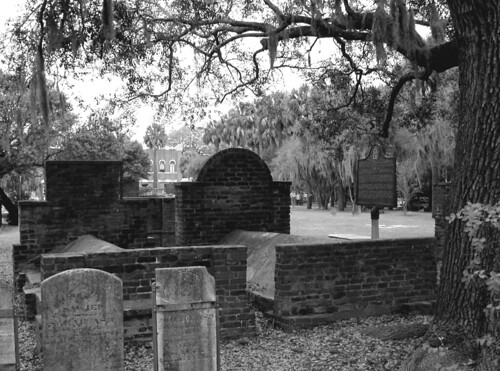
Savannah tombs
SAVANNAH, Ga. – Often called the “Belle of the South” because of its charm, Savannah probably wasn’t “too beautiful” to burn when union troops stormed the Confederate states at the close of the Civil War.
The city then looked much like most dusty cotton towns along the Atlantic Coast south of the Mason-Dixon Line, which separates the North and South, a guide told tourists on one of the modern city’s popular historic walking tours.
Savannah folks received word that Gen. William Tecumseh Sherman was heading their way after his troops burned Atlanta to the ground in November 1864 in his “March to the Sea” campaign.
Everyone fled for their safety, including the men who had the messy job of removing the many piles of horse manure that littered the streets. Not only was Savannah average, it’s air must have contained a foul odor when Sherman arrived because he decided to spare the city from ruin, the guide said.
The general would later write about Savannah as having been “far too beautiful a city to burn.”
The general, the guide explained, was likely putting a spin on the story to the mainstream press, which moved slowly on horseback or by stagecoach in 1865 because many of the South’s railways had been destroyed in the fighting. The reporters had begun to catch up with Sherman’s troops when they arrived in Savannah.
Some had already published reports of the travesties the soldiers committed in Atlanta. Southerners were growing angrier by the day over how the soldiers had ripped up railroad tracks, wrapping some around tree trunks like pretzels. Even the newly freed slaves were upset with Sherman for the way his followers had been treating them, the guide said.
Regardless of which story is accurate, those who have inherited the city are blessed with an urban historic district whose beauty is unmatched in the United States.
The city had the fortune of being discovered by Oxford-educated James Oglethorpe and 21 other Englishmen who settled Georgia to maintain their homeland’s stake in the 13 colonies.
Laid out in 1733, Oglethorpe gave the city a new design of streets and alleys offset by six 60-foot-by-90-foot squares that was uncommon to colonial America. There would be a 44 acre farm shared by landowners on the outside of the town. As the city grew and gobbled up the farm, city planners continued laying out streets with the same pattern of public squares.
Today, these impeccably maintained parks are home to historic markers, statues and ornate fountains under the shade of tall “live oak trees draped in Spanish moss.” The streets also are lined by row after row of stately brick houses with richly adorned secret gardens.

Savannah town square

In 2005, the city attracted more than 6 million visitors who, combined, spent more than $1.7 million, according to Georgia Trend magazine. The tourism boom is largely based on the heritage trade, which has spoken volumes to the value of historic preservation.
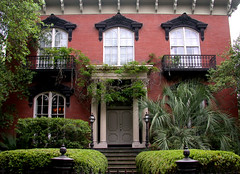
The Civil War walking tour, meanwhile, passed the stately home of Jim Williams, whose scandalous murder trial became the inspiration for the best-selling book, “Midnight in the Garden of Good and Evil.” Tourists also flock there for walking tours of the house and other sites associated with Williams, an antiques dealer who was acquitted on charges he shot and killed his male lover.

Garden is out back

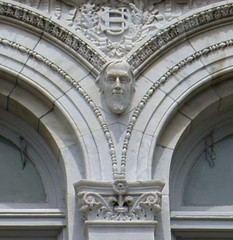
Our guide also stopped at the stately post office, which holds a tiny sculpture of President Lincoln peering down from above two second-story windows. The massive marble and granite building was a gift to the city during the reconstruction era that followed the Civil War.
Its architect was believed to have incorporated Lincoln’s face into the building as a reminder that the president would “always be looking down on us,” the guide explained.

Lincoln head
Published with permission of the Observer-Reporter