a newspaper man adjusts his pen

Monday, April 30, 2007

Mystery among the rocks


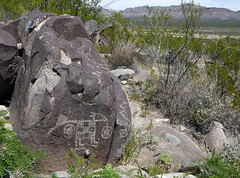
The goggle-eyed and horned creatures are the most mysterious images to be found at ancient petroglyphs in beautiful Southeastern New Mexico. Some scholars believe goggle eyes in a Mexican rain god while others insist the Native Americans who etched the stone art had their own religious reasons to get creative. Maybe these strange creatures are renditions of the same aliens that “unofficially” landed centuries later about 80 miles to the east in Roswell.

You can sense the magic of Three Rivers Petroglyphs upon setting foot on the rugged path that wraps around the rocks and boulders that contain 21,000 crudely-etched pictures. The sweet smell of evergreen fills the air, while breathtaking vistas spread for miles on both sides of the Tularosa Basin 28 miles south of Carrizozo. The San Andres Mountains are to the west, while the Sacramento Mountains fill the eastern horizon. There are few houses interupting the landscape, as most buildings were evacuated and raised after the U.S. Military uprooted everyone in the 1950s and 60s for military purposes.

Three Rivers Petroglyphs

It is believed that the Jornada Mogollon tribe is responsible for the carvings of masks, sunbursts, animals, hand prints, fish, fauna and geometric designs created 1,000 years ago. Unfortunately, many of them are fading away under the elements. No one is sure what they mean, as there are no known surviving members of the tribe. There are theories that the site might have been used for trading, that each picture represents part of a larger story. “The rock art seems to reflect a strong supernatural and religious connection to their environment,” according to the visitor brochure issued by the Bureau of Land Management.

Sunday, April 29, 2007

Women rule this tribe


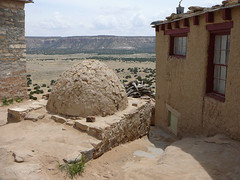
It might not be wise to cross paths with Acoman women, especially their youngest daughters. They hold the truth and power among siblings in families that make up the 4,000-member Native American tribe in New Mexico. It’s a cherished tradition in this matriarchal society that maintains the oldest continuously inhabited pueblo in the United States. Females also own all of the property.

Acoma, Sky City

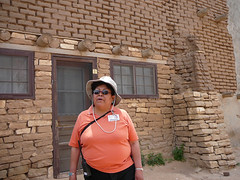
“A woman was the first person to rise from the ground,” says Dean, shown above, a mesa landowner and tour guide at Sky City, their rustic village on a mesa rising 357 feet above the “enchanted” lowlands about an hour’s drive west of Albuquerque. The female messiah sent fourth four warriors in separate directions, representative of north, south, east and west, as well as the changing seasons. They returned to report to her that it was safe for humans to inhabit the world, Dean says, repeating a story told by generations of woman who came before her.

“The people of the white rock” were likely drawn to this high ground for added security, that has outlived an invasion by Spanish conqueros in the 1500s. The Acomans had decided to put just one small door on the first floor of their adobe houses. In times of great fear, women would stand guard inside these entries, ready to club the first intruders over the head, Dean says. They also may have helped to toss 13 Spaniards off the cliffs when the men attempted to steal the village grain supplies in 1598.

Acoma, Sky City

Today, about 30 people live on the mesa that, each year, attracts thousands of tourists, who have included actor John Wayne and former First Ladies Jackie Kennedy and Hillary Clinton. The presidents' wives must have honored the rules that place strict limits on photography and against wandering on the cemetery, where Acomans are buried five deep in soil brought to the rock. If a white person ignores tribal rules, the violation can be settled with a .45-calibre handgun, Dean says. She claims to be joking.

Flirting with chile


The waitress says I look like a chile relleno kind of guy when I ask for her suggestions on the menu at a Mexican restaurant in Albuquerque, N.M. But I am leaning toward the carnitas asadas, or grilled pork tenderloins swimming in red chile and green chile. “I always know how to read my customers,” insists Dina, my Latino American waitress at La Hacienda Restaurant in an ancient adobe building in the city’s Old Town district. Many of these mud-colored, Pueblo-Spanish-style buildings here date to 1706, when Albuquerque was settled along the banks of the Rio Grande as a colonial farming village and military outpost. At its center is San Felipe Neri Roman Catholic Church, which has been in continuous use for nearly 300 years. The smell of peppers cooking circle the air around the church and every other corner of the several blocks that make up this tourist destination. As it turns out, my three breaded and deep-fried chile rellenos don't bring tears to my eyes. Their seeds, which could burn holes through a weak tongue, had been scraped off to put out the fire, Nina explained. I like them. “Did I read you right?” she says with a wink.

Friday, April 27, 2007

Child soldier


We all seem to know these people, the ones who complain almost endlessly about their “pathetic” problems. They can be especially annoying when they appear to have otherwise successful lives, and the money to afford to keep their families warm and safe.

These folks should be required to read “A Long Way Gone,” the memoirs of a boy soldier from Sierra Leone, Africa. One day Ishmael Beah is a 9-year-old learning to rap songs from America with his friends. Almost overnight, he has an AK-47 strapped to his back after a mass movement of refugees attempt to flee violence in his homeland. He is swallowed up by the government army by the time he reaches his 13th birthday, only to be rescued by UNICEF three years later.

“Memories I sometimes wish I could wash away, even though I am aware that they are an important part of what my life is; who I am now,” Beah writes in his book.

Somehow, he manages to find the courage to come to grips with his past, even though he could find more than enough on his plate to complain about. But he gazes out with joy in his eyes and a wide smile in a photograph from the book’s back cover.

Tuesday, April 24, 2007

Welcome home soldier


Relatives of U.S. Army Sgt. Keith Knezovich were so happy to have him back safe after a year in Iraq that they decorated a Christmas tree to welcome him home to Beallsville, Pa.

Follow this link to a photo of him and his mom Debbie.

Dinner in the delta

Mekong rice farmer welcomes Americans
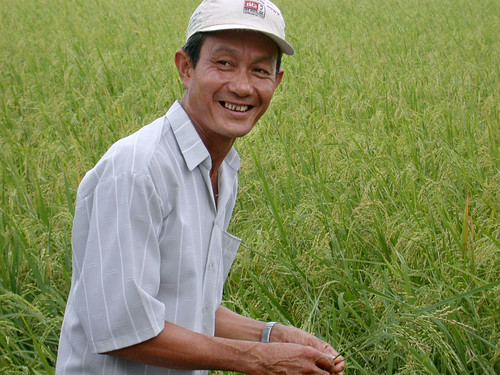
Tu Man, above, has been having good rice harvests, making him a middle-class, head-of-the-household in Vietnam. The average worker in Vietnam is lucky to earn the equivalent of $40 U.S. dollars a month. Tu Man is smiling, too, for impressing his neighbors, by having American visitors.


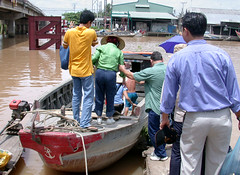
ALONG THE MEKONG DELTA, Vietnam – The rice boat's engine sputters, stalls and spouts thick, smelly black oil on its passengers.

They wipe themselves down with newspapers and rags while its engine cranks and churns back to life, pushing the boat again down the Mekong Delta.

The weathered gray wooden boat is not carrying its normal haul of rice weighing 10 tons. It is parading two Americans on a sweltering mid-July afternoon along the muddy brown delta the Vietnamese call Cuu Long, or River of Nine Dragons.

Vietnam veteran Neal Armagost of Reynoldsville is aboard with his wife, Thanh, a Vietnamese immigrant to Pennsylvania, en route to give a rice farmer photographs of his newborn granddaughter in the United States. An American newspaper reporter is at their side, invited by Thanh Armagost to glimpse the life of an average hard-working farm family in Vietnam.
Delta5

Onlookers, many of whom have probably never seen Americans, smile and stare from thatched huts on stilts lining the riverbank and passing boats hauling exotic fruits.

Children splash at the river's edge while a group of women stoop to wash clothes.

"The water is poison," a young man named Hieu said, blaming the pollution on runoff from rice paddies that have been sprayed too often with pesticides.

Downstream, the farmer's family is preparing a feast that is costing it about $40, the monthly salary earned by most workers in Vietnam.

The boat anchors at a small plank dock after navigating under a narrow bamboo monkey bridge villagers built to cross the river.

Everyone follows a path covered with terra-cotta shards leading to the rice farmer's home, passing well-manicured papaya and mango orchards. A barefoot boy uses his hands and feet to shimmy to the top of a palm tree to retrieve a dozen coconuts to serve the fruit's cool, refreshing milk.

Inside the four-room, one-story white stucco house, a woman drains blood from the neck of a red-feathered chicken that will become dinner.

The menu also includes rice noodle soup with pork and beef, seafood rolls, fresh-baked bread and banh xeo, or Vietnamese pancakes.

Thanh Armagost passes around photographs of 5-month-old Loan Thy Vu, the daughter of her nephew, whom she raised. The baby's mother, who also lives with the Armagosts, is a daughter of the rice farmer, Tu Man.

"I miss her already," said Ba Noi, the grandmother on the father's side of the family. The wrinkles on the 88-year-old woman's tanned face testify to the hours she spends under the sun tending to the vegetables, two-thirds of which are sold to sustain the family.After dinner, Tu Man beams while leading his visitors to his paddies, showing them how he toils in fields, hand-harvesting each stalk of rice. The men return to the head table to share bottles of Saigon beer.

"I respect the American soldiers," said Tu Man, whose youthful appearance helped him avoid serving in the South Vietnam army three decades ago.

He later lines up his family on the front porch in view of the Americans' cameras for a group photograph, a special occasion in this village without such conveniences as telephones.

It is time to return to port, where the farmer leaves his visitors with hugs and kisses on their cheeks.